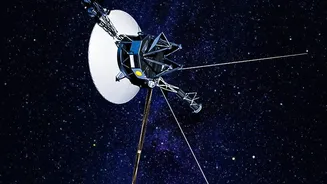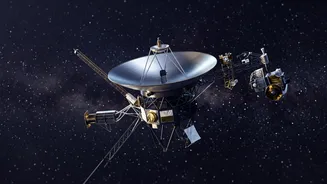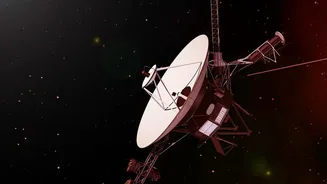



Launched in 1977, NASA's Voyager 1 is about to reach a milestone no human object has before. On November 18, it will be one light-day from Earth, a distance so vast it profoundly changes how we communicate with our farthest robotic explorer.
A Landmark in Deep Space
On November
18, 2026, after nearly 50 years of travel, Voyager 1 will be approximately 25.9 billion kilometres from home. This isn't just another number on its cosmic odometer; it marks the moment the spacecraft is officially one light-day away. A light-day is the distance light travels in a full 24 hours. To put that into perspective, light from our Sun takes just over eight minutes to reach Earth. A signal sent to Voyager 1 on this date will take an entire day to arrive, even while travelling at about 300,000 kilometres per second. This milestone isn't a physical boundary in space, but a human one, powerfully illustrating the immense scale of Voyager’s journey into the cosmos.
The Great Cosmic Delay
The reason for the ever-growing communication lag is straightforward: distance and the unbreakable speed limit of the universe. Radio waves, which NASA's Deep Space Network uses to 'talk' to the probe, are a form of light and cannot travel any faster. As Voyager 1 continues to speed away from us at nearly 61,000 kilometres per hour, the gulf its signals must cross constantly widens. The November 18 milestone means a simple round-trip conversation—sending a command and receiving confirmation that it was executed—will take a minimum of 48 hours. This incredible delay forces mission engineers at the Jet Propulsion Laboratory to plan days in advance, working with a machine that is almost unimaginably remote.
Whispers Across the Void
Communicating with Voyager 1 isn't just slow; it's incredibly difficult. After decades in the harsh environment of space, the probe's systems are showing their age. Its power is supplied by three radioisotope thermoelectric generators, which convert heat from decaying plutonium into electricity. This power source loses about four watts of energy per year, forcing NASA to make difficult decisions about which instruments to keep running. Recently, engineers have performed clever power-shuffling maneuvers to extend the life of the remaining science instruments. The challenges were highlighted in October 2026, when the spacecraft went silent for 48 hours before contact was re-established, a stark reminder of the mission's fragility.
Forty-Nine Years and Counting
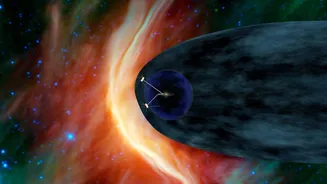
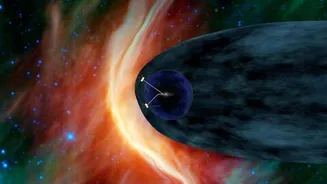
Originally designed for a five year mission to study Jupiter and Saturn, Voyager $^$s longevity is a testament to its robust $^$s engineering. After its planetary flybys, it became the first human made object to enter interstellar space in $^$$^$$, crossing the boundary known as the heliopause where the Sun $^$s influence gives way to the vast expanse between stars. Now, with just two of its original ten science instruments still active, it continues to send back invaluable data about the interstellar medium. Its journey is far from over; the probe is currently heading in the general direction of a star named Gliese $^$$, though it won $^$t pass near it for another $^$$,$$$ years.