
Imagine discovering a new world, only for it to vanish years later. This isn't science fiction; it's a real cosmic detective story that unfolded 25 light-years from Earth, leaving astronomers to solve the ultimate disappearing act.
A Landmark Discovery
In 2008, the world of
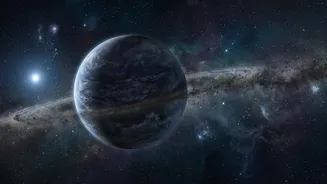
astronomy was buzzing with excitement. Using the powerful Hubble Space Telescope, scientists announced they had taken one of the first-ever direct images of a planet outside our solar system. Named Fomalhaut b, this distant world appeared as a distinct dot of light orbiting the bright star Fomalhaut. For years, evidence for exoplanets was mostly indirect, relying on detecting the wobble of a star or the dimming of its light. Seeing an actual planet, or so it seemed, was a groundbreaking achievement. It was hailed as a major step forward in our quest to find other worlds, offering a tangible glimpse into a planetary system beyond our own. Initial estimates suggested it was a massive gas giant, perhaps up to three times the mass of Jupiter.
The Puzzles of a Phantom Planet
Almost immediately, Fomalhaut b began to present astronomers with frustrating puzzles. For a planet of its supposed size, it was behaving very strangely. While it was exceptionally bright in visible light, it gave off no detectable heat in the infrared spectrum. This was a major red flag. Large, young planets are expected to be relatively warm and glow in infrared light. The absence of this heat signature was a mystery that didn't quite fit the picture of a conventional gas giant. Some astronomers theorised that the brightness might be coming from a massive ring of dust and ice orbiting the planet, perhaps created by a collision. Furthermore, its orbit appeared highly unusual and not the neat, elliptical path expected of a planet in a stable system. The clues were mounting that Fomalhaut b was not what it seemed.
The Great Disappearing Act
The mystery deepened dramatically when astronomers, led by András Gáspár at the University of Arizona, re-examined all the archival Hubble images of the Fomalhaut system. As they reviewed the observations taken between 2004 and 2014, they witnessed something astonishing. The bright dot they had identified as a planet was fading. Over the course of a decade, it grew dimmer and more diffuse. Then, in the images from 2014, it was gone. Fomalhaut b had completely vanished. Planets do not simply disappear. As Gáspár noted, the object was 'doing things a bona fide planet should not be doing'. The vanishing act was the final, definitive clue that astronomers were not looking at a planet at all.
A Cosmic Crash Investigation
The solution to the mystery was more spectacular than anyone had imagined. The new theory, published in 2020, concluded that Fomalhaut b was never a planet. Instead, what the Hubble telescope had captured back in 2004 was the immediate aftermath of a cataclysmic collision between two massive icy bodies orbiting the star. The researchers calculated that the colliding objects were likely a mixture of ice and dust, each approximately 200 kilometres in diameter. This titanic impact created a massive, expanding cloud of incredibly fine dust particles. It was this cloud of debris that Hubble had first detected. What astronomers mistook for a planet was actually a ghost—an ephemeral cloud of dust masquerading as a solid world.
Solving the Ghostly Clues
This 'collision cloud' theory elegantly solved all of the nagging puzzles. The cloud would have been very bright in visible light as the tiny dust particles scattered the starlight from Fomalhaut, but it wouldn't have been massive enough to generate its own detectable heat, explaining the lack of an infrared signal. As the debris from the impact expanded over the years, the cloud grew larger and more spread out. Consequently, it became fainter and more diffuse, until it eventually became so sparse that it was no longer visible to Hubble by 2014. Witnessing such an event is incredibly rare; scientists estimate a collision of this magnitude may only happen in the Fomalhaut system once every 200,000 years. It seems astronomers were in the right place at the right time to see the aftermath of this cosmic smashup.