



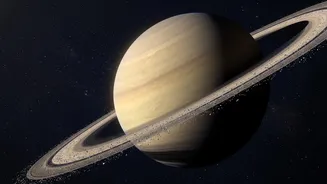
A Tale of Two Poles
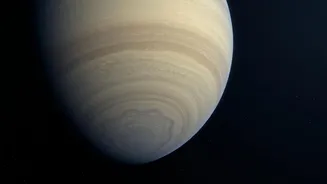
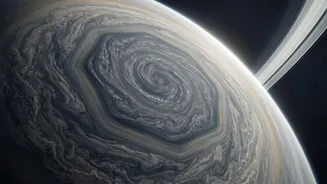
When we think of Saturn's atmospheric oddities, the famous northern hexagon immediately comes to mind. First spotted by the Voyager spacecraft in the early 1980s, this six-sided jet stream is a remarkably stable and unique feature in our solar system.
For a long time, it was thought to be a one-of-a-kind phenomenon. While the north had its hexagon, the south pole was dominated by a massive, hurricane-like vortex, but with no apparent geometric structure. This stark difference puzzled scientists, who wondered why two poles on the same gas giant would behave so differently. The south pole's vortex was known to be a 'hot spot', warmer than its surroundings, a feature that was also surprisingly discovered at the perpetually dark north pole, suggesting these vortices are intrinsic to the planet and not just a result of sunlight.
A New Shape Emerges
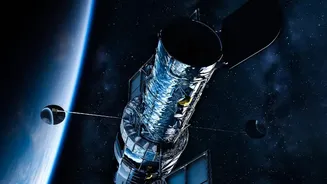
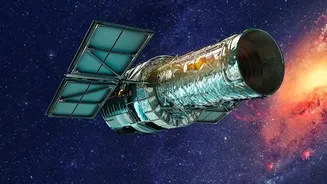
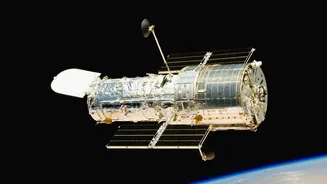
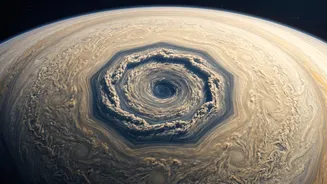
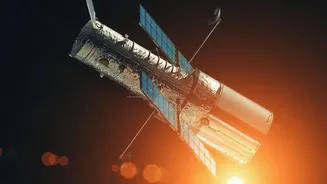
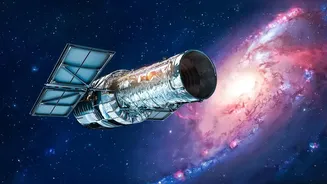
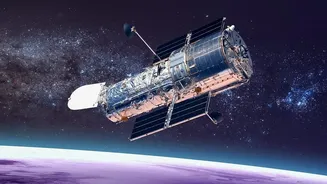
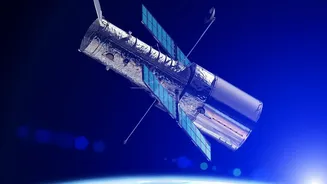
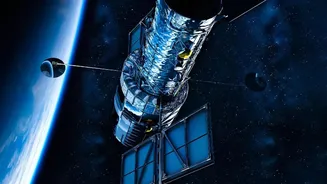
The story took a dramatic turn recently. Because of Saturn's tilt, its south pole was hidden from Earth's view from 2012 until 2023. When astronomers using the Hubble Space Telescope finally got a clear look again, they found a surprise. A new, massive, 10-sided polygon—a decagon—had formed in the clouds circling the south pole. This discovery, reported in September 2026, was stunning. The Cassini spacecraft, which studied Saturn for 13 years until its mission ended in 2017, had never seen such a structure, meaning this decagon must have formed sometime after Cassini's demise. This finding proves that Saturn's polar geometry is far from static and that the 'unique' hexagon might not be so unique after all.
What Causes These Giant Shapes?
The formation of these colossal geometric patterns is a matter of intense study. They are essentially giant standing waves in the planet's jet streams. On a gas giant like Saturn, with no solid landmasses to disrupt wind flow, atmospheric forces can create very orderly, symmetrical patterns. Scientists believe that interactions between different atmospheric layers and smaller vortices pinching a larger polar jet stream force the flow into a polygonal shape. Fluid dynamics experiments in labs have successfully recreated hexagons and other polygons by spinning fluid at different speeds, supporting the idea that the shapes are a natural consequence of the planet's deep atmospheric flows. The difference between the north's hexagon and the south's newer decagon might be due to variations in atmospheric composition or seasonal effects that alter the intensity of the jet streams in each hemisphere.
How the Decagon Differs
While both poles now host a polygon, they are not identical twins. The northern hexagon is a long-lived, stable feature that has been observed for over 40 years. The southern decagon, on the other hand, appears to be newer and potentially less stable. It is also significantly larger than its northern counterpart. Furthermore, while the hexagon is almost stationary, locked in place with Saturn's rotation, the decagon appears to be migrating slowly eastward. These differences provide scientists with a valuable opportunity to compare the two phenomena in real-time. By studying how and why these two similar-but-different structures formed on the same planet, researchers can learn much more about the complex weather patterns that govern gas giants.
A Planet Full of Surprises
The discovery of the southern decagon highlights just how much we still have to learn about our own solar system. Saturn, it seems, still has the ability to surprise us. The Cassini mission provided a treasure trove of data that scientists will be analyzing for decades, revealing everything from the dynamics of its rings to hurricane-like storms at both poles. But the emergence of a brand-new, giant atmospheric feature years after the mission ended proves that continuous observation is key. The Hubble Space Telescope, along with powerful ground-based observatories, will continue to monitor Saturn's poles, watching to see how the decagon evolves and whether it will persist for decades like the hexagon, or if it is a more transient feature. These observations are crucial for understanding the powerful forces that shape planetary atmospheres across the galaxy.