



In the vastness of space, even the smallest objects can present the biggest puzzles. A tiny asteroid named 1998 KY26 is moving in a way that defies simple explanation, showing a mysterious acceleration that has researchers racing to find the cause.
Meet the Cosmic Top
Asteroid
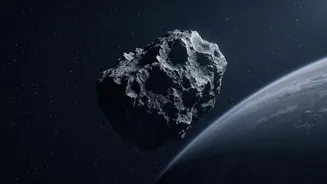
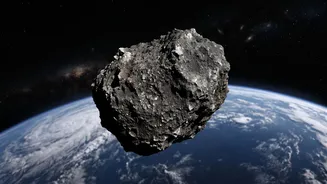
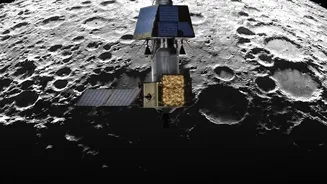
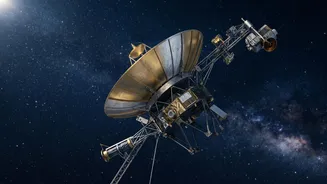
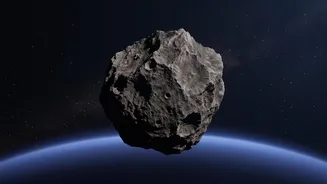
1998 KY26 is not your average space rock. For starters, it is incredibly small, measuring just about 11 meters (36 feet) in diameter, roughly the size of a small bus. Discovered in 1998, what makes this asteroid truly remarkable is its rotation. It spins on its axis once every 5.35 minutes, making it one of the fastest-rotating objects ever observed in our solar system. Imagine a day that lasts less time than it takes to boil an egg. This rapid spin puts it in a special class of celestial bodies, ones that are so small and fast that they test the limits of our understanding of asteroid physics. Because of its unique characteristics, Japan's Hayabusa2 spacecraft is on a long journey to visit it, with an expected arrival in July 2031.
A Mysterious Push
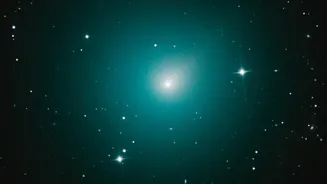
The core of the mystery surrounding 1998 KY26 is its movement. In addition to the predictable pull of gravity from the Sun and planets, the asteroid is exhibiting a slight, but significant, acceleration. This isn't an increase in its orbital speed, but rather a push perpendicular to its path around the sun. Such 'non-gravitational' forces are not unheard of, but on an object this small, their cause becomes a fascinating puzzle. One of the initial theories was that 1998 KY26 might be a 'dark comet'. This would mean it's releasing gas from buried ice, which would act like a tiny thruster, pushing the asteroid off its expected course. This outgassing would be too faint to create a visible tail, hence the 'dark comet' name.
Too Hot for Ice?
However, recent research has cast doubt on the dark comet theory. A new study from aerospace engineers at the Georgia Institute of Technology suggests the asteroid is simply too warm to sustain the buried water ice needed for outgassing. Their thermal models show that even the coldest parts of the asteroid average around minus 61 degrees Celsius. For water ice to persist long enough to explain the acceleration, temperatures would need to be much colder, below minus 128 degrees Celsius. At its current temperature, any ice driving the acceleration would have vanished in as little as 62 years. While this weakens the outgassing hypothesis, it doesn't solve the mystery. If not ice, what is pushing this tiny asteroid around?
The Sun's Gentle Nudge
With the dark comet theory looking less likely, scientists are turning their attention to another subtle force: sunlight itself. The Yarkovsky effect describes a tiny push an asteroid receives from thermal radiation. As the asteroid rotates, it absorbs sunlight on its 'day' side and radiates that heat away from its 'afternoon' side. This emission of thermal photons acts like a minuscule, but constant, thruster. Over long periods, this gentle nudge can significantly alter an asteroid's orbit. For a very small and light object like 1998 KY26, this effect could be strong enough to explain the observed acceleration without needing any outgassing. Recent analysis supports this, suggesting the Yarkovsky effect, combined with the asteroid's updated size and rapid spin, could account for the movement.
Why This Tiny Rock Matters
Studying the strange behavior of a bus-sized rock millions of kilometers away might seem abstract, but it has crucial implications. Understanding non-gravitational forces like the Yarkovsky effect is vital for planetary defense. These tiny pushes, accumulating over decades, can be the difference between an asteroid safely passing Earth or being set on a collision course. By precisely measuring these effects on small bodies like 1998 KY26 and Bennu (visited by NASA's OSIRIS-REx mission), scientists can dramatically improve their ability to predict the longterm paths of potentially hazardous asteroids. The upcoming visit from Hayabusa2 will provide the final word, offering an upclose look that will either confirm the Yarkovsky effect is the culprit or reveal an entirely new phenomenon at play.