





The Ghost in the Machine
Since the 1920s, quantum mechanics has been the most successful theory for describing the subatomic world. But it has always had a strange feature: its core equations, like the famous Schrödinger equation, depend on complex numbers. A complex number is
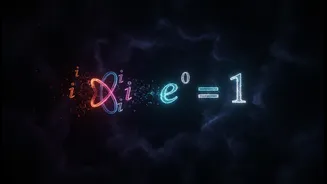
a combination of a regular 'real' number and an 'imaginary' one, a multiple of the square root of -1, represented by the symbol i. This has long puzzled physicists. After all, the things we measure in the real world—position, momentum, energy—are always real quantities. For decades, many wondered if these imaginary numbers were a fundamental feature of reality or just a convenient mathematical trick. Recent history seemed to settle the debate; a 2021 paper argued that any version of quantum theory without complex numbers would fail to match experimental results for entangled particles, and experiments in 2022 appeared to prove it.
Finding a New Recipe
The latest breakthrough, however, challenges that conclusion directly. In a series of recent papers, teams of physicists in Europe have successfully built a version of quantum mechanics using only real numbers that produces the exact same predictions as the standard, complex-number version. They achieved this by questioning a basic assumption. The experiments that previously 'proved' complex numbers were necessary relied on a standard textbook method for mathematically combining multiple quantum particles, known as the tensor product. The new research proposed that for a real-number theory, a different combination rule is required. By developing a new mathematical framework for how particles relate to each other, they were able to construct a complete and consistent theory without a single imaginary number in sight.
Convenience, Not Necessity
So, what does this actually change? In terms of experimental predictions or developing new quantum technologies, the immediate answer is nothing. The new real-number theory gives all the same results as the old one. Its significance is more profound and philosophical. It suggests that complex numbers are not a fundamental component of the universe but rather a very effective form of mathematical shorthand. Think of a complex number like 3 + 4i as just a neat package for two real numbers (3 and 4). The new theory essentially unbundles that package and creates a bookkeeping system to track the two real numbers separately, proving that the 'imaginary' part was a helpful tool, not an essential ingredient of reality. This demotes complex numbers from a law of nature to a matter of convenience, much like how they are used in other fields like electrical engineering.
The Important Fine Print
However, this mathematical rewrite comes with a crucial caveat, as noted in the headline. The current working models of real-number quantum mechanics are limited to describing systems with a finite number of quantum states. While this covers many important scenarios, many real-world physics problems, particularly in quantum field theory, involve systems with an infinite number of possible states. Extending this new formulation to these infinite-dimensional systems is the critical next step, and researchers are already exploring how it might be done. Until it can successfully describe both finite and infinite systems, real-number quantum theory remains a compelling but incomplete alternative to the long-reigning standard model.