



Beyond the Chalkboard
For generations, the advanced physics classroom has relied on a few key tools: the textbook, the chalkboard, and the physical lab. While essential, these methods have their limits. Textbooks can be dry and two-dimensional. Physical labs, while crucial
for hands-on learning, are often expensive, limited in scope, and can even pose safety risks. You can't exactly recreate a particle collision or bend spacetime with a set of beakers and a Bunsen burner. This is particularly true in India, where many schools lack the funding for high-end experimental apparatus, creating an accessibility gap for students aspiring to careers in science and technology.
Enter the Virtual Laboratory
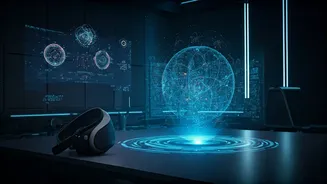
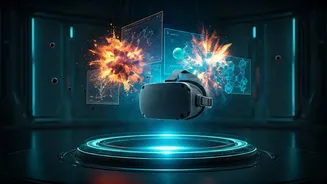
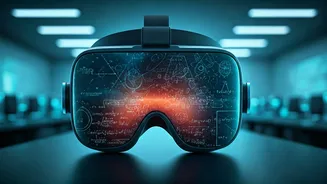
This is where predictive AI and virtual reality (VR) models come in. Imagine a student putting on a VR headset and stepping not into a game, but into a fully interactive physics laboratory. This isn't just a pre-recorded animation. It's a dynamic, simulated environment powered by artificial intelligence. The VR component provides the immersive, 3D visualisation, allowing a student to 'walk' around a model of a solar system or 'see' magnetic field lines. The AI is the brain behind the operation. It runs complex physics simulations in real time, predicting the outcomes of a student's actions. What happens if you increase the mass of a star? The AI calculates the gravitational effects and the VR shows you the result instantly.
Making the Impossible Possible
The true power of this technology lies in its ability to make abstract and impossible scenarios explorable. Students can conduct experiments that are physically impossible in a school setting. For instance, they can fly towards a black hole to witness gravitational lensing, observing how light bends around its immense mass—a core concept of Einstein's theory of relativity. They could design a hypothetical particle accelerator, smash virtual atoms together, and analyse the resulting subatomic debris, all guided by AI that ensures the simulation adheres to the laws of quantum mechanics. Students can change variables on the fly—the angle of incidence of a light ray, the velocity of a projectile, the charge of a particle—and see an immediate, scientifically accurate result. This transforms learning from passive memorisation into active, inquiry-based discovery.
An Opportunity for Indian Education
In the Indian context, the potential is enormous. These virtual labs can act as a great equaliser, providing students in remote or under-resourced schools with access to world-class experimental facilities. Instead of just reading about the Large Hadron Collider, they can experience a simulation of it. This can democratise access to high-quality STEM education and spark an interest in science from an early age. Moreover, it offers a safe environment to experiment with concepts like nuclear reactions or high-voltage electricity without any physical danger. It allows for endless repetition and trial-and-error, a luxury not always afforded by expensive and delicate real-world equipment.
The Road Ahead: Challenges and Promise
Of course, this transformation won't happen overnight. The hurdles are significant. The cost of VR headsets, powerful computing hardware, and sophisticated software is still a major barrier for widespread adoption in the Indian school system. Furthermore, teachers will require extensive training to move from being lecturers to facilitators of these virtual experiences. Developing high-quality, curriculum-aligned content that is both engaging and scientifically rigorous is another major challenge. However, as hardware becomes cheaper and ed-tech companies in India and abroad continue to innovate, these tools are moving from the realm of science fiction to plausible reality. Pilot programmes in universities and elite schools are already demonstrating their value.