




A Cosmic Collision Course
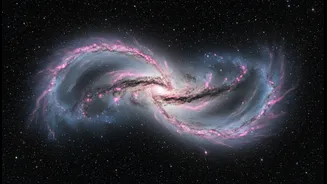
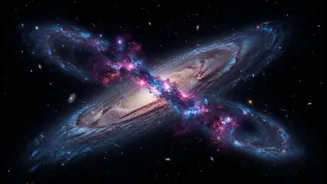
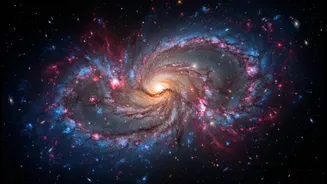
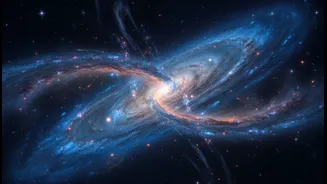
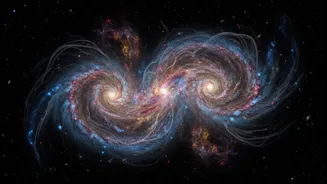
Imagine two colossal clouds of smoke slowly swirling towards each other before mixing. Now, replace the smoke with billions of stars, vast dust lanes, and giant clouds of gas. That’s a galactic merger. These events are not quick crashes but slow, powerful
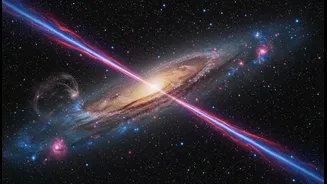
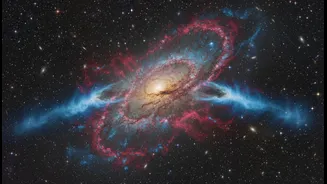
dances that can take hundreds of millions of years. As galaxies draw closer, gravity begins to tear them apart, pulling streams of stars and gas into long, graceful arcs. These mergers are a fundamental part of cosmic evolution, eventually resulting in larger, reshaped galaxies. One of the most famous examples is Centaurus A, a galaxy 13 million light-years away that is the result of a clash between a large elliptical galaxy and a smaller spiral galaxy. Its distinct, warped shape gives us a glimpse into the chaotic forces at play.
The Universe's Invisible Scaffolding
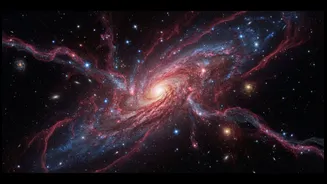
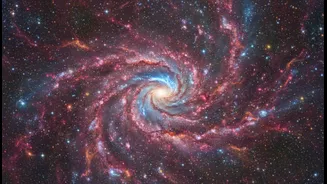
Lacing through all galaxies is an unseen web of magnetic fields. While far weaker than the magnetic field of our own planet, these interstellar fields span thousands of light-years and play a crucial role in the cosmos. Scientists believe they act like an invisible skeleton for galaxies, influencing the movement of gas and helping to regulate how stars are born. In a stable spiral galaxy, these magnetic fields often follow the graceful curve of the spiral arms. However, until recently, what happened to this delicate structure during the extreme violence of a merger was largely a matter of theory.
Seeing the Twist and Shout
New observations, particularly from NASA's now-retired flying observatory SOFIA, have provided the first clear look at how magnetic fields behave in a merger. By observing infrared light that can pass through thick cosmic dust, astronomers can map the alignment of tiny dust grains, which line up with magnetic field lines. In Centaurus A, these images revealed a fascinating story. On the outskirts of the galaxy, the magnetic fields were found to run parallel to the old dust lanes, a calm remnant of the original spiral galaxy. But closer to the galaxy's chaotic core, the fields are a tangled mess. The collision has distorted, twisted, and amplified the magnetic fields, supercharging them. This amplification appears to be a key mechanism, potentially explaining how the weak magnetic fields of the early universe grew into the powerful forces we see today.
Fuel for Furious Starbirth
This magnetic chaos does more than just look dramatic; it has a profound effect on the galaxy. Galactic mergers often trigger incredible bursts of star formation, creating new suns at a rate far higher than in peaceful galaxies. It was once thought this was purely due to gravitational forces compressing gas clouds. However, new studies of merging galaxies like Arp 220 show that the powerful, tangled magnetic fields play a key role. They can act like a pressure cooker, trapping gas and preventing it from being blown away by the radiation from young, hot stars. This confined gas then has a greater chance to collapse and form even more stars. The magnetic fields can also slow the rotation of gas, allowing gravity to pull it inward to fuel the starburst.
Why This Cosmic Tangle Matters
Understanding how magnetic fields are warped in galactic mergers isn't just about one strange galaxy. It provides vital clues to how all galaxies, including our own, evolve. These mergers were more common in the early universe, and the process of amplifying magnetic fields may have been a crucial step in shaping the cosmos we see today. The findings also help us look into our own distant future. The Milky Way is on a collision course with our nearest large neighbour, the Andromeda galaxy, with the merger expected to begin in about 4.5 billion years. By studying systems like Centaurus A and Arp 220, we get a preview of the cosmic transformation that awaits our own galactic home, driven by the powerful and invisible forces of magnetism.