


The Sun Today: A Stable Star
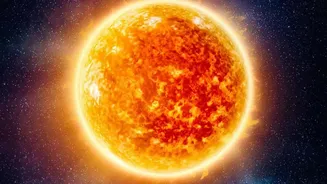
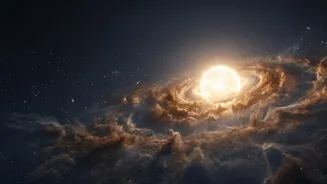
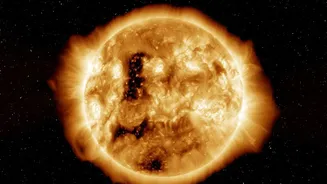
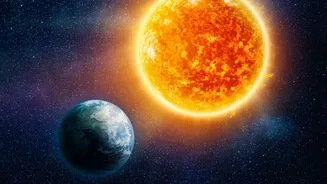
For the last 4.6 billion years, the Sun has been in the most stable phase of its life, known as the main sequence. Deep within its core, immense pressure and temperature force hydrogen atoms to fuse into helium, releasing a tremendous amount of energy.
This process, nuclear fusion, creates an outward pressure that perfectly balances the inward pull of gravity, keeping our star a steady, life-giving orb. Our Sun is about halfway through this phase and will remain in this stable state for another 4 to 5 billion years before the first signs of its demise begin to appear.
The Beginning of the End: The Red Giant
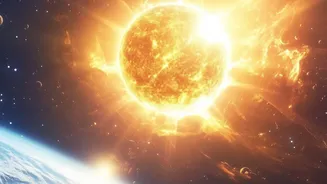
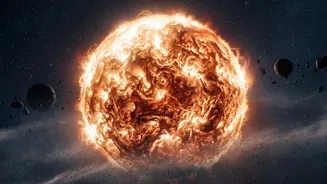
The long, slow process of dying begins when the Sun exhausts the hydrogen fuel in its core. Without the outward force of fusion, gravity will start to win, causing the core to contract and heat up. This increased heat will ignite hydrogen fusion in a shell surrounding the now-helium-rich core. This new burst of energy will cause the Sun's outer layers to expand dramatically, swelling to hundreds of times its current size. As it expands, its surface will cool and glow with a reddish hue, transforming it into a red giant. This phase will mark the end of the solar system as we know it.
Fate of the Inner Planets
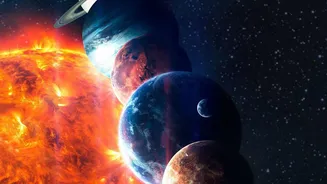
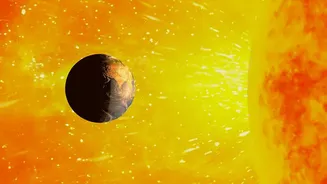
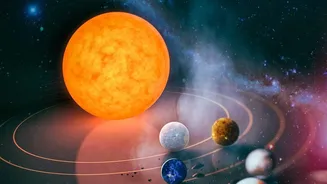
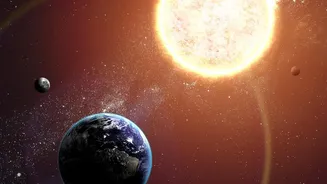
The Sun's expansion will be catastrophic for the inner planets. Mercury and Venus, being the closest, will be the first to be completely engulfed and vaporised by the star's expanding atmosphere. Earth's fate is less certain but equally grim. Even before being swallowed, our planet will become uninhabitable. In about a billion years, the gradually brightening Sun will trigger a runaway greenhouse effect, boiling our oceans and stripping away the atmosphere. Some models predict the expanding Sun will consume Earth, while others suggest that as the Sun loses mass, its gravitational pull will weaken, potentially allowing Earth to drift into a wider, albeit scorched, orbit. Mars may face a similar race between the Sun's expansion and its own widening orbit.
Chaos for the Outer Giants
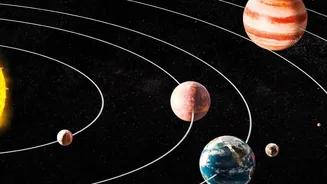
The outer planets — Jupiter, Saturn, Uranus, and Neptune — will escape being engulfed. As the Sun sheds nearly half its mass, its weakened gravity will cause these gas giants to drift into larger orbits. For a long time, it was thought their new orbits would remain stable for trillions of years. However, recent studies from 2026 suggest a much more chaotic future. These new models propose that the Sun won't lose mass smoothly but through uneven ejections, giving the dying star tiny gravitational 'kicks'. These kicks could destabilize the outer planets' orbits within a billion years, leading to collisions, planets swapping orbits, or even being ejected from the solar system entirely.
The Final Act: Planetary Nebula and White Dwarf
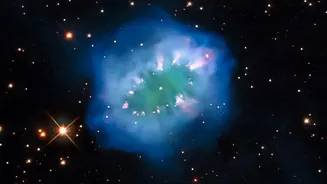
After the red giant phase, the Sun's core will become hot enough to fuse helium into carbon and oxygen. Eventually, this fuel will also run out. With no more energy being produced, the Sun will become unstable and puff off its outer layers into space. These expelled layers of gas and dust will form a beautiful, glowing structure called a planetary nebula, illuminated by the star's exposed core. This nebula will disperse over about 10,000 years. All that will remain of our magnificent star is a dense, Earth-sized remnant known as a white dwarf. Incredibly hot but no longer producing new energy, this stellar core will slowly cool and fade over trillions of years, eventually becoming a cold, dark black dwarf.