




So, What’s the Cosmic Gossip?
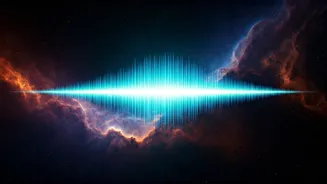
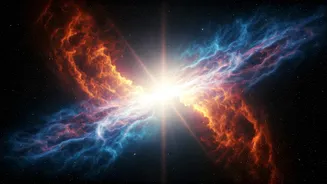
The universe is full of blips and flashes, but astronomers are currently captivated by a specific class of events known as Fast Radio Bursts, or FRBs. These are incredibly powerful, yet millisecond-long, blasts of radio waves from distant galaxies. Most
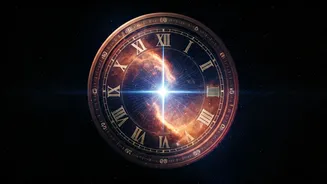
of them flash once and are never heard from again. The real mystery, the one that has everyone talking, involves the 'repeaters'. These are FRBs that flash over and over, sometimes with a mystifying pattern. Scientists have detected repeaters that send out signals on a predictable schedule, almost like a cosmic clock, before going quiet for a period and then starting again. This regularity is strange and hard to explain with typical cosmic events like random star explosions.
Not Your Average Space Noise
To be clear, these signals are not messages in English; they are bursts of energy. But their structured nature is what makes them so compelling. Think of it this way: a single firework is just a bang. But a firework show where the explosions happen every 10 seconds, on the dot, for an hour? That implies some kind of mechanism or intelligence behind it. The energy released in one of these millisecond bursts can be equivalent to what our sun puts out in three days. Yet, the cause remains one of the biggest puzzles in modern astronomy. The bursts are so powerful at their source that they can be detected from billions of light-years away, yet so faint by the time they reach us, they are said to be a thousand times weaker than the signal from a mobile phone on the Moon.
The Scientists Are Typing…
In the global scientific community, this is the hottest topic in the group chat. Astronomers are racing to point every telescope they can at these repeating sources whenever they 'turn on'. The leading natural explanations involve some of the most extreme objects in the universe, like magnetars—a type of neutron star with an incredibly powerful magnetic field. A magnetar in our own galaxy was even linked to an FRB, which was a huge step forward. But even the magnetar theory doesn't perfectly explain all the different types of FRBs, especially the ones with very specific repeating patterns. The debate is fierce and fascinating, with every new data point adding another layer to the mystery. It is a frontier of discovery, where every observation could be the one that cracks the code.
Meanwhile, On Planet Earth…
Beyond the labs and observatories, the mystery of FRBs has captured the public imagination. The idea of a repeating signal from deep space is catnip for anyone who has ever looked up at the stars and wondered, 'Are we alone?'. Social media platforms are filled with speculation, ranging from well-researched enthusiast theories to wild memes about cosmic alarm clocks or an intergalactic society trying to get our attention. This phenomenon is a modern example of how a complex scientific puzzle can become a cultural touchstone, uniting people in shared curiosity and wonder. It’s a reminder that the universe can still serve up mysteries so profound that they make everyone stop and listen.
Could It Actually Be Aliens?
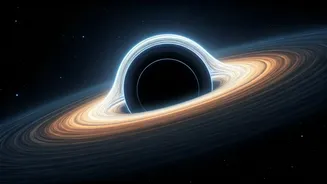
Let’s just get it out of the way: whenever there's an unexplained pattern from space, the 'alien' hypothesis comes up. This idea, often associated with concepts like 'alien megastructures' or Dyson Spheres, suggests an advanced civilization could be the source. Most scientists, however, approach this with extreme caution. The rule in astronomy is to exhaust every possible natural explanation before considering an artificial one. While the idea of a 'technosignature' from another civilization is a falsifiable hypothesis and a valid subject for scientific inquiry, it remains a very long shot. The current focus is on understanding the bizarre physics of magnetars, black holes, and other exotic objects that could be responsible. But until a natural cause is definitively proven, the tantalizing question will always linger in the background of the conversation.