





A Celestial Meeting in the Twilight
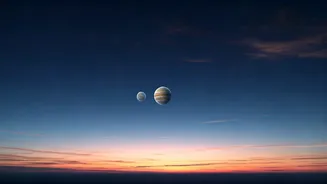
Imagine the Sun has just set, painting the western horizon with shades of orange and purple. Just as the brightest stars begin to appear, you notice three brilliant points of light clustered together, shining with a steady, serene glow unlike the twinkling
of stars. This isn't a fleet of UFOs; it's a planetary conjunction, a beautiful line-of-sight illusion where planets in our solar system appear to meet. One of the most stunning examples in recent memory was the grand convergence of Mercury, Venus, and Jupiter. For several evenings, these three worlds engaged in a slow, silent dance, rearranging themselves into different triangular formations each night. It was a breathtaking spectacle, a reminder of the vast, clockwork-like nature of our solar system, visible to anyone with a clear view of the horizon.
The Science of a Planetary 'Huddle'
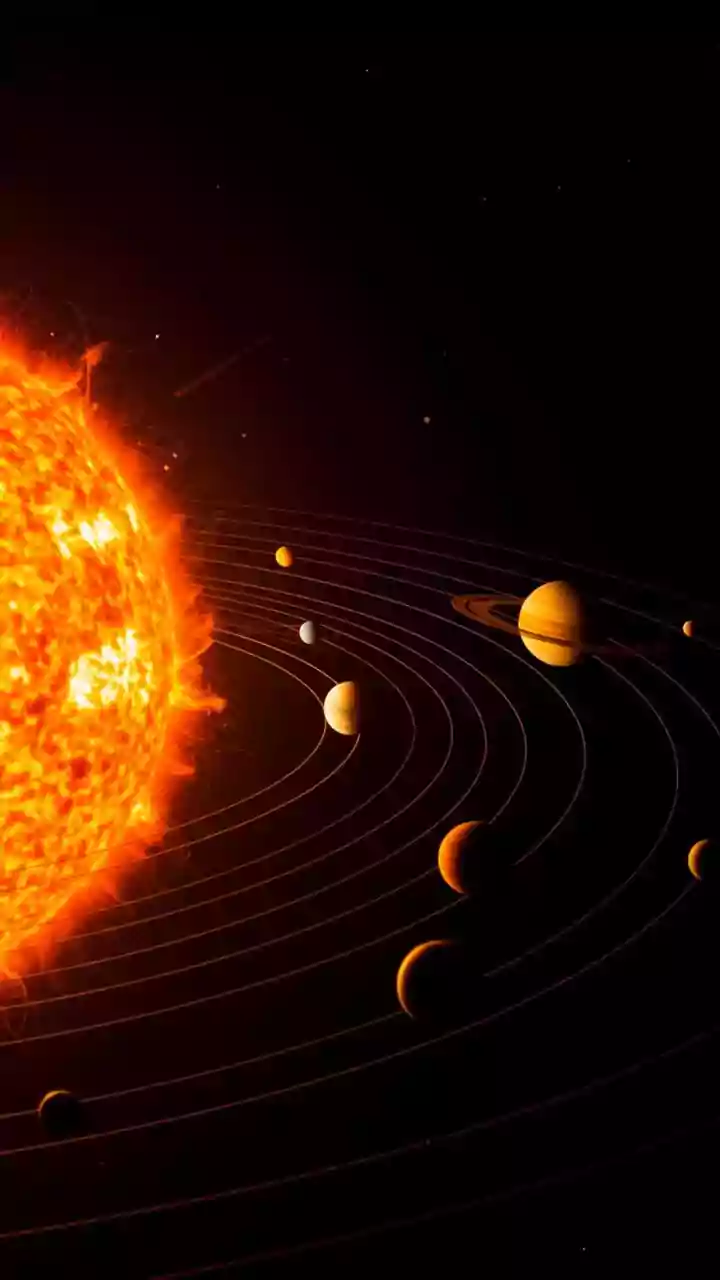
How can planets that are millions of kilometres apart appear to be touching? The secret lies in perspective. A planetary convergence, or conjunction, is not a physical meeting. The planets remain in their own distinct orbits, separated by unfathomable distances. It's an optical illusion from our vantage point on Earth. As we and our neighbouring planets orbit the Sun, our lines of sight to them constantly shift. Occasionally, from our perspective, two or more planets appear to pass very close to each other in the sky. Think of it like seeing two distant trees on a hillside appearing right next to each other, even though you know one is much farther away. This celestial alignment is what creates the captivating visual of a planetary huddle.
The Three Star Players
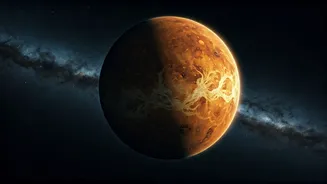
What made this particular alignment so special was the cast of characters. Each planet brought its own unique personality to the celestial stage. Venus, often called the 'Evening Star' or 'Morning Star', is the brightest object in our night sky after the Moon. Its brilliance is due to its thick, highly reflective cloud cover and its relative closeness to Earth. It's almost always the showstopper in any alignment. Jupiter, the king of planets, is the largest planet in our solar system. Even from hundreds of millions of kilometres away, its immense size makes it shine as a spectacularly bright, non-twinkling 'star'. Mercury is the most elusive of the trio. As the innermost planet, it never strays far from the Sun in our sky. This means it's only visible for short periods during twilight, often lost in the Sun's glare. Seeing Mercury at all is a treat; seeing it alongside two other bright planets is exceptionally rare and a true reward for sky-gazers.
Your Guide to Catching the Next Show
While the grand trio of Mercury, Venus, and Jupiter was a specific event, planetary conjunctions happen fairly regularly. You don't need expensive equipment to enjoy them, just a bit of knowledge and patience. Here’s how you can prepare for the next celestial performance: 1. **Know When and Where to Look:** Keep an eye on astronomy news websites or use a sky-gazing app on your phone (like Stellarium, SkyView, or Star Walk). These tools will tell you which planets are visible and when they will have a close encounter. 2. **Find a Dark Spot:** While bright planets like Venus and Jupiter can be seen from cities, the experience is always better away from city lights. Find a park, a rooftop, or drive a short distance out of town for a clearer view. 3. **Timing is Everything:** Many conjunctions, especially those involving Mercury or occurring near the Sun, are best viewed during a short window just after sunset (in the west) or just before sunrise (in the east). Be ready and in position before the show starts. 4. **Use Binoculars:** Even a simple pair of binoculars can dramatically enhance your view. You might be able to see the phases of Venus or even the four largest moons of Jupiter, appearing as tiny pinpricks of light beside the planet.