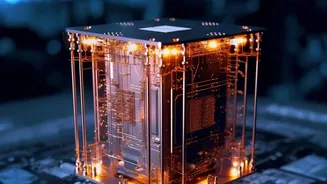







The Engine Room of Our Digital Lives
Think of a data centre as a physical home for the internet. It's a secure, purpose-built facility packed with thousands of computer servers, storage systems, and networking equipment that work together to store, process, and distribute the vast amounts
of information we create and consume daily. From the photos you upload to the cloud and the videos you stream, to the complex calculations behind a simple online transaction, it all happens inside these buildings. India's data centre market is booming, with capacity expected to more than double by 2026, driven by rising internet use and government initiatives. This positions the country as a critical hub in the global digital economy.
An Unprecedented Surge in Demand
The demand for data centre capacity is exploding, fuelled by two key trends. First is our ever-increasing reliance on digital services. The second, and more recent, driver is the meteoric rise of artificial intelligence. Training and running AI models, especially generative AI like ChatGPT, requires enormous computational power. An AI server rack can draw significantly more power than a traditional one. This surge in AI workloads is a primary reason the International Energy Agency (IEA) projects that global electricity demand from data centres could more than double between 2022 and 2026. In India, the data centre industry's power demand is expected to see a massive increase, testing the national grid.
The Soaring Energy and Emissions Bill
This immense computing power comes at a cost. Globally, data centres already account for 1-1.5% of all electricity consumption, a figure comparable to the airline industry. The continuous operation of servers generates immense heat, meaning a huge portion of a data centre's energy bill—often over 40%—goes towards sophisticated cooling systems just to prevent overheating. This intense energy use contributes to global greenhouse gas emissions, with data centres responsible for an estimated 2.5% to 3.7% of the world's total. As India's data centre capacity grows, its share of the national electricity demand is projected to climb from under 1% to as high as 3% by 2030, posing a significant challenge to the country's net-zero goals.
The Hidden Thirst for Water
Beyond electricity, many data centres have another significant environmental footprint: water consumption. A vast majority of large data centres use water-based evaporative cooling systems because they are highly effective. A single large-scale facility can consume millions of gallons of water per day, comparable to the water usage of a small town. This can place a significant strain on local water resources, particularly in water-stressed regions. The rise of AI exacerbates this issue; some estimates suggest that by 2027, global AI demand alone could require billions of cubic metres of fresh water annually for cooling. Often, this is potable drinking water drawn directly from municipal supplies.
The Quest for a Greener Cloud
The good news is that the industry is acutely aware of these challenges, and the push for 'green data centres' is gaining momentum. In India, companies are increasingly investing in renewable energy sources like solar and wind to power their facilities, often through long-term power purchase agreements. Innovations focus on improving Power Usage Effectiveness (PUE), a metric for energy efficiency, and reducing Water Usage Effectiveness (WUE). Solutions range from advanced liquid cooling technologies that are more efficient than air cooling, to building data centres that are certified by green building standards. In India, several states now tie incentives for data centres to the use of at least 30% renewable energy, signalling a regulatory push towards sustainability.