



A Cosmic Clock with an Expiry Date
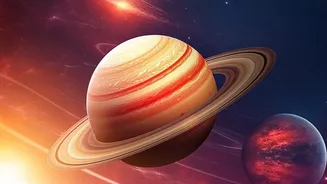
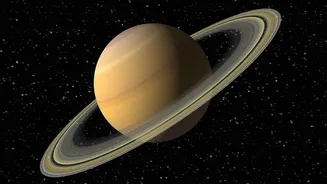
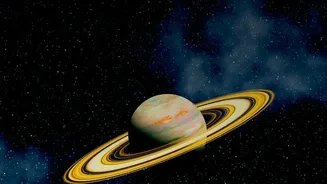
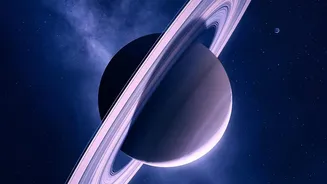
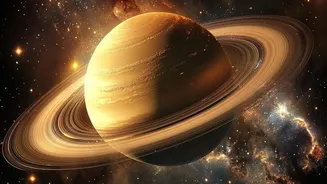
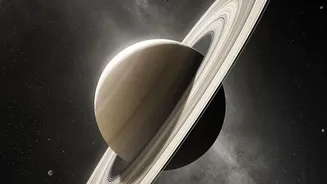
For a long time, astronomers assumed Saturn's rings were as old as the planet itself, forming some 4.5 billion years ago. However, data from NASA's Cassini spacecraft, which studied the planet for 13 years, has painted a dramatically different picture.
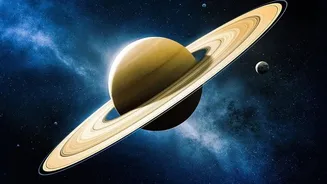
The rings are surprisingly young, likely forming just 10 million to 100 million years ago. This means they may have appeared during the age of dinosaurs on Earth. The evidence lies in their brightness and mass. Made of 99% pure water ice, the rings are remarkably clean. Over billions of years, they would have been darkened and polluted by a constant bombardment of micrometeoroids. Their pristine nature suggests they haven't been around long enough to accumulate much cosmic dust. More startling is the discovery that these iconic rings are disappearing. A phenomenon dubbed "ring rain" is pulling material from the rings into Saturn's atmosphere at a staggering rate, enough to fill an Olympic-sized swimming pool every half hour. At this pace, the entire ring system could be gone in as little as 100 million years, a mere blink in cosmic time.
Solving a Solar System Mystery
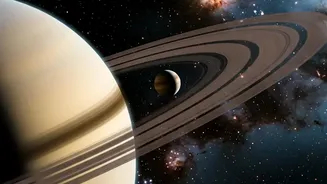
The revelation that the rings are a temporary feature lends weight to a dramatic origin story. Instead of forming with Saturn, it’s now believed the rings are the result of a cosmic catastrophe. One leading hypothesis suggests that an icy moon, or perhaps a passing comet, strayed too close to Saturn and was ripped apart by the planet’s immense gravity. In 2022, simulations supported the idea of a destroyed moon, which scientists nicknamed "Chrysalis." More recent research from early 2026 suggests an even more complex event involving the collision of two large, icy moons hundreds of millions of years ago. This cataclysmic impact could have not only created the rings but also triggered the formation of several of Saturn's modern inner moons, like Rhea and Dione, and even caused the planet's significant axial tilt. By studying the mass, composition, and dynamics of the rings, scientists are effectively conducting forensic astronomy, piecing together the violent history of the Saturnian system.
A Model for How Worlds Are Made
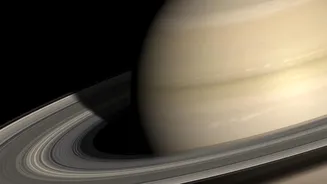
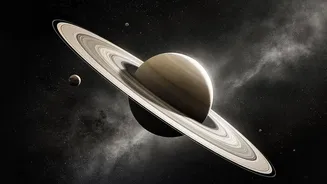
This is where the story of Saturn's rings expands to tell us about our own origins. The processes happening within the rings today are a small-scale, observable version of what happened in the early solar system. Over 4.6 billion years ago, our solar system was a giant, swirling disk of gas and dust known as an accretion disk. Within this disk, tiny particles began clumping together, drawn by gravity, eventually forming larger and larger bodies that grew into the planets we see today. Scientists can see similar processes at play in Saturn's rings. Small particles of ice and rock clump together to form moonlets. The gravitational pull of these tiny embedded moons, some only a kilometre across, creates intricate patterns like waves, gaps, and propeller-like wakes in the ring material. By studying these interactions, researchers gain invaluable insights into the fundamental physics of planetary formation—a process we can't otherwise go back in time to watch.
Looking Out to Look Back
The insights from Saturn don't just apply to our own solar system's past; they inform our search for life and planets elsewhere in the galaxy. The dusty, particle-filled disks around distant young stars, known as protoplanetary disks, are the birthplaces of exoplanets. These disks are incredibly far away and difficult to study in detail. Saturn’s rings provide a nearby analogue that can be observed with incredible precision. Understanding how ring material interacts, how it's influenced by moons, and how it ultimately falls into the planet helps astronomers refine their models of planet formation everywhere. For instance, the discovery that ring rain heats Saturn's upper atmosphere could provide a new 'fingerprint' for scientists to look for when trying to determine if a distant exoplanet has its own ring system. Essentially, by understanding the temporary nature of Saturn's rings, we are fortunate to be living in a time that provides a unique window into one of the universe's most fundamental creative processes.