



The Heavy Burden of Chemical Rockets
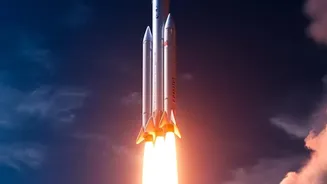
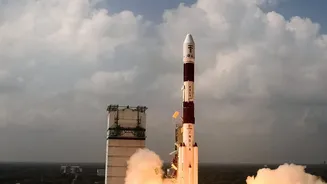
For decades, space travel has been dominated by chemical propulsion. This method works by burning propellants to create a powerful, high-thrust explosion that pushes a spacecraft. Think of it as a controlled, massive shove. It's incredibly effective for
breaking free of Earth's gravity and getting into orbit quickly. However, it comes with a significant drawback: fuel is extremely heavy. For a traditional communications satellite weighing four tonnes, as much as half of that mass can be just the chemical fuel required for orbital adjustments throughout its life. This mass is expensive to launch and limits the space available for the actual payload, like the transponders and sensors that perform the satellite's mission.
A New Push: Electric Propulsion
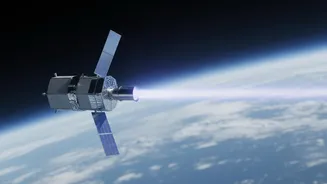
Plasma thrusters, a form of electric propulsion, work on a completely different principle. Instead of a powerful, brief explosion, they provide a gentle but continuous push. These thrusters use electrical power, typically from solar panels, to ionize a small amount of inert gas like xenon, turning it into plasma—the fourth state of matter. An electric and magnetic field then accelerates these charged particles (ions) and shoots them out at incredibly high speeds, generating thrust. This exhaust can travel much faster than the exhaust from a chemical rocket, a key measure known as specific impulse. A higher specific impulse means you get more push for the same amount of propellant.
The Mass-Saving Advantage
The incredible efficiency of plasma thrusters is what leads to dramatic mass savings. Because they use propellant so efficiently, a satellite needs to carry far less of it. A satellite that would have needed two tonnes of chemical fuel might only require about 200 kilograms of xenon gas for an electric propulsion system. This reduction in propellant mass frees up a huge amount of capacity. ISRO can either launch the same satellite on a smaller, cheaper rocket or use the same rocket to launch a satellite packed with more revenue-generating transponders or sophisticated scientific instruments. This shift fundamentally changes the economics of satellite launches and operations, allowing for more powerful payloads and longer mission lifespans because the fuel lasts longer.
ISRO's Leap into Electric Propulsion
ISRO is actively developing and integrating this technology into its future missions. The space agency has successfully completed a 1,000-hour life test of its own 300mN Stationary Plasma Thruster, a major milestone demonstrating its reliability. These Indian-developed thrusters are slated to be validated in space on the upcoming Technology Demonstration Satellite (TDS-01). This mission will serve as a crucial proof-of-concept for using electric propulsion not just for minor orbital corrections (station-keeping) but also for the more demanding task of orbit raising. By mastering this technology, ISRO aims to replace chemical propulsion systems in its future communication satellites, enhancing self-reliance and boosting the capacity of its satellite fleet.
The Trade-Off: A Game of Patience
While highly efficient, plasma thrusters have one major trade-off: low thrust. Their gentle push is not nearly enough to launch a rocket from Earth. Even in space, manoeuvres take much longer. Using electric propulsion to raise a satellite to its final geostationary orbit can take several months, compared to just a week with a powerful chemical engine. This requires a different mission-planning philosophy, where speed is traded for efficiency. However, for many commercial and scientific missions where operational lifespan and payload capacity are more critical than the initial transit time, it's a trade-off well worth making. The long-term benefits of reduced launch costs and extended satellite functionality are set to redefine India's capabilities in space.