



A Continent of Two Halves
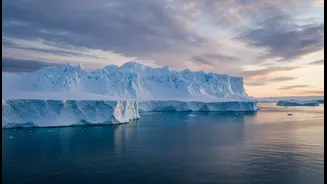
Antarctica isn't one single block of ice. It’s best understood as two distinct regions: East and West Antarctica, separated by the massive Transantarctic Mountains. The East Antarctic Ice Sheet is colossal, containing enough ice to raise global sea levels
by over 50 metres. For a long time, it was considered relatively stable. The West Antarctic Ice Sheet is smaller, holding about 5 metres of sea-level rise potential, but it is far more vulnerable. Much of its base rests on bedrock that lies below sea level, creating a precarious situation where the ocean can directly interact with the ice. This fundamental difference is why much of the recent alarming news has come from the western side of the continent.
Discovery 1: The Ocean’s Hidden Assault
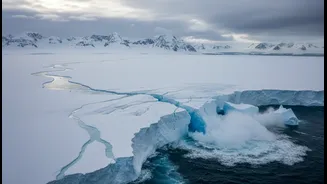
Perhaps the most critical discovery in recent decades is that Antarctica's biggest threat is often invisible, coming from below. Scientists have found that relatively warm ocean water is flowing beneath the floating ice shelves that fringe the continent. This water, known as Circumpolar Deep Water, is only a few degrees above freezing, but that’s warm enough to melt the ice from its base. Researchers using remote-controlled submarines and satellite data have mapped vast channels and cavities being carved out under the ice, particularly in West Antarctica. This process is aggressively attacking glaciers like Thwaites and Pine Island, eating away at their foundations, causing them to thin, and accelerating their slide into the sea. A study from July 2026 even linked the retreat of Pine Island Glacier directly to human-caused ocean warming that began decades ago.
Discovery 2: A Catastrophic Tidal Pump
For years, models assumed that this warm water could only attack the very edge of a glacier. However, recent, incredibly detailed satellite observations have revealed a shocking new mechanism. At the Thwaites Glacier—nicknamed the 'Doomsday Glacier' for its potential to trigger a wider collapse—scientists discovered that the entire glacier lifts and settles with the daily tides. As it lifts, it allows warm, high-pressure seawater to surge miles inland beneath the ice, into an area called the grounding zone where the ice rests on the seafloor. This daily influx of warm water acts like a pump, vastly increasing the area of ice being melted from below. This discovery, published in 2026, fundamentally changes our understanding of how quickly a glacier's retreat can accelerate once this process begins.
Discovery 3: Cracks From Within
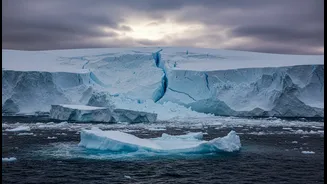
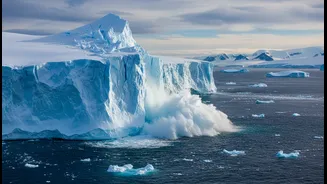
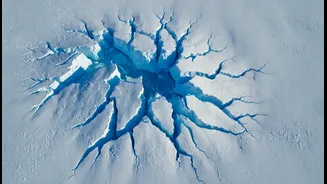
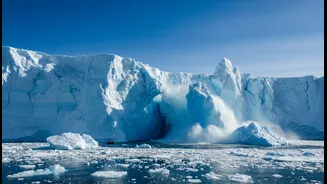
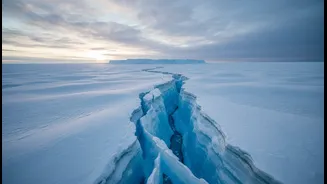
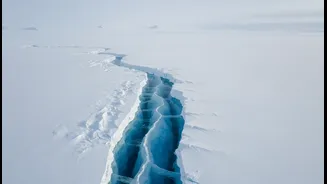
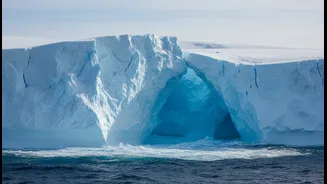
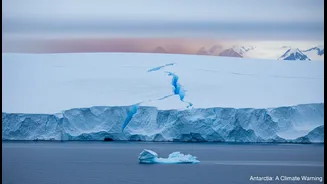
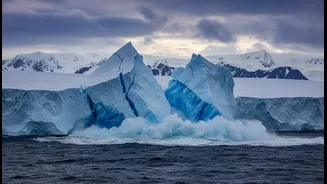
The danger isn't just from the ocean. Scientists are also closely watching how the ice is breaking apart on its own. One process is called 'hydrofracturing', where meltwater on the glacier's surface pools in crevasses. This water is denser than ice, and its weight drives the cracks deeper, potentially breaking off huge sections. Another, more alarming theory is 'marine ice cliff instability' (MICI). This suggests that as a glacier retreats, it could leave behind towering, unstable ice cliffs. These cliffs could then collapse under their own weight, leading to a runaway chain reaction of disintegration. Recent satellite imagery of the Thwaites ice shelf shows it is actively shattering, with large areas beginning to fall to pieces, suggesting these mechanical failures are already underway.
Discovery 4: The Sleeping Giant Stirs
While West Antarctica gets the headlines, scientists have stopped assuming the East is entirely safe. Once considered a 'sleeping giant', the East Antarctic Ice Sheet is now showing signs of vulnerability. Studies have revealed subglacial valleys that could allow warm ocean water to penetrate deep inland and reach the base of major eastern glaciers, such as the Totten and Denman glaciers. Though the process is not as advanced as in the west, these findings challenge the long-held belief of the East's invulnerability. Research shows that if global warming continues unchecked, even this massive ice sheet could begin to contribute significantly to sea-level rise in the coming centuries, a sobering thought for a nation like India with its extensive and densely populated coastline.