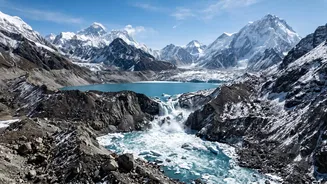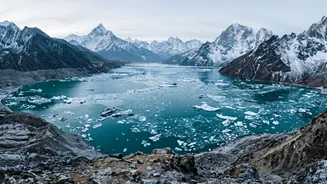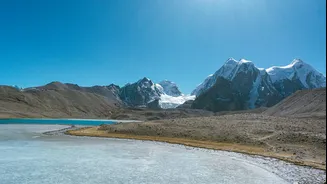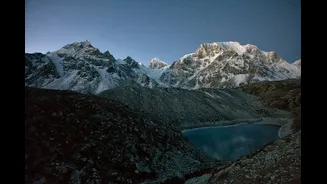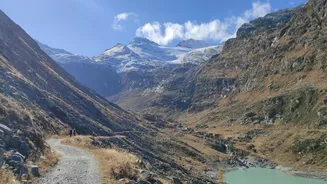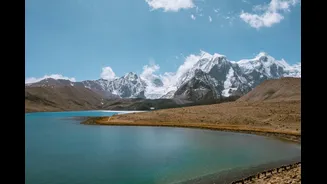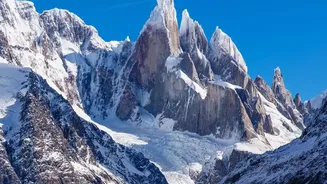



The majestic Himalayas, often called the 'Third Pole', are facing a critical threat. UN-backed reports warn that accelerating climate change is creating unstable glacial lakes, putting millions of people in India and neighbouring countries at risk.
Understanding Glacial Lake Outburst Floods
A Glacial
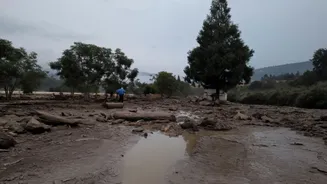
Lake Outburst Flood, or GLOF, is a sudden and often catastrophic release of water from a lake formed by melting glaciers. These lakes are typically dammed by unstable natural barriers of ice and moraine—loose rock and debris left by a retreating glacier. When this fragile dam fails, it can unleash a terrifying wall of water, mud, and boulders down mountain valleys. Triggers for such a breach can include rockfalls, avalanches, earthquakes, or simply the immense pressure of the growing body of water itself. Unlike predictable seasonal flooding, GLOFs are sudden, violent, and can travel vast distances, destroying everything in their path, from villages and roads to critical infrastructure like hydropower plants.
The UN's Alarming Assessment
Recent warnings from the United Nations and associated scientific bodies paint a grim picture. Reports highlight that the Himalayan region is warming much faster than the global average, dramatically increasing the frequency and severity of GLOF events. A 2023 study noted that 15 million people globally are at risk from GLOFs, with more than half living in just four countries: India, Pakistan, China, and Peru. UN officials have stated that the population at risk in the Himalayan region alone runs into the millions, a number that has likely grown since initial assessments. The UN Environment Programme (UNEP) has emphasised that exceeding the 1.5°C global warming target will lead to large-scale, and in many cases irreversible, impacts on the world's glaciers and ice sheets.
Why India Is Acutely Vulnerable
India's extensive Himalayan frontier, home to thousands of glaciers and glacial lakes, places it in a high-risk category. States like Jammu and Kashmir, Arunachal Pradesh, Sikkim, Himachal Pradesh, and Uttarakhand are particularly vulnerable. One study noted that Jammu and Kashmir has the highest number of high-danger lakes, while Arunachal Pradesh and Sikkim face significant threats to cropland and hydropower projects, respectively. A pre-publication UN-led report revealed a devastating statistic: between 1835 and 2025, India recorded the highest number of deaths from GLOFs among eight Hindu Kush Himalayan countries, with over 6,000 fatalities. Past disasters, such as the 2013 Kedarnath flood and the 2021 Chamoli event, serve as tragic reminders of the destructive power of these mountain hazards.
The Cascade of Consequences
The danger from a GLOF doesn't end with the initial flood. The long term consequences are equally severe. The destruction of hydropower projects threatens energy security, while the demolition of roads and bridges can isolate entire communities for extended periods. Agricultural land is often buried under metres of sterile debris, destroying livelihoods. Furthermore, these events underscore the transboundary nature of the threat. A GLOF originating in one country can have devastating impacts downstream in another, as recently demonstrated when a breach at Bhutan's Shintaphu Lake triggered flood alerts and evacuations in West Bengal and Assam. This highlights the critical need for regional data sharing and coordinated disaster response efforts.
A Race Against Time for Solutions
While the situation is critical, it is not hopeless. The warnings are a call to action. Key strategies involve improving monitoring and establishing robust early warning systems for communities downstream. Some mitigation measures involve engineering solutions, such as carefully draining high risk lakes to reduce pressure on their natural dams. In India, the Central Water Commission monitors hundreds of glacial lakes, and a National GLOF Risk Mitigation Project is underway in several vulnerable states. However, UN officials have cautioned that technology alone cannot prevent loss on such a massive scale, especially in the face of a 'Himalayan tsunami' sized event. Ultimately, the most effective long term solution is to tackle the root cause: climate change. Experts stress that rapid and deep cuts in global greenhouse gas emissions are essential to slow the rate of glacial melt and buy precious time for adaptation.