


A Breakthrough Transmission
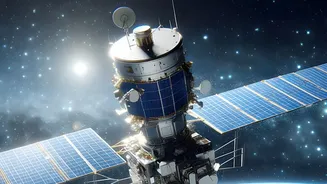
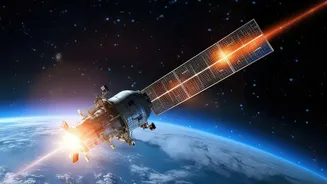
NASA recently achieved a major milestone in space exploration by successfully streaming high-definition video from deep space using lasers. In a key test, the Deep Space Optical Communications (DSOC) experiment beamed an ultra-high-definition video from the Psyche
spacecraft to Earth. This initial test, conducted from a distance of about 31 million kilometres, achieved a maximum data rate of 267 megabits per second (Mbps). For context, streaming a 4K movie at home requires a connection of around 25 Mbps. The 15-second video, which humorously featured a cat named Taters, took only 101 seconds to reach our planet, demonstrating a communication speed far superior to current systems.
How Laser Communication Works
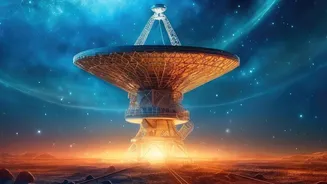
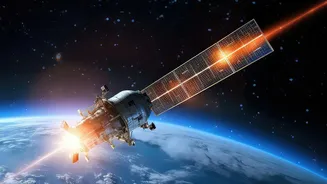
For decades, space missions have relied on radio waves to communicate with Earth. Think of radio waves like a floodlight, spreading their signal over a wide area. This makes them reliable but also inefficient, as the signal weakens over vast distances, leading to low data rates. Laser communication, or optical communication, is fundamentally different. It uses a tightly focused beam of near-infrared light, much like a laser pointer. By encoding data into these light pulses, the system can pack much more information into the signal. This method allows for data rates that are 10 to 100 times faster than the best radio frequency systems used by missions today.
The Psyche Mission's Critical Test
This revolutionary technology is being tested aboard NASA's Psyche spacecraft, which launched in October 2023. While Psyche's main goal is to study a unique metal-rich asteroid, it carries the DSOC system as a technology demonstration. Over the course of its journey, the DSOC experiment has consistently broken records. After its initial success, it transmitted data from as far as 350 million kilometres away—a distance greater than that between the Earth and Mars. Though the data rate decreases with distance, even at 226 million kilometres, it maintained a speed of 25 Mbps, still outperforming conventional radio. The successful completion of its final tests in late 2025 has proven the technology is reliable and ready for future missions.
Faster, Lighter, and More Secure
The benefits of laser communication extend beyond just speed. The hardware required for optical systems is smaller, lighter, and uses less power than comparable radio equipment. This is a huge advantage in spacecraft design, where size, weight, and power are critical considerations that impact launch costs and mission capabilities. Furthermore, the narrow focus of a laser beam makes the communication stream inherently more secure. Unlike wide-broadcast radio waves, which can be intercepted, a laser signal is extremely difficult to jam or tap into without being directly in its path.
What This Means for the Future of Exploration
This technological leap is set to transform humanity's future in space. For upcoming crewed missions to the Moon and Mars, high-bandwidth communication is essential. It means astronauts could send back high-resolution images, stream live video, and transmit vast amounts of scientific data in near real-time. This not only enhances the scientific return from missions but also improves the connection between astronauts and Earth, which is vital for long-duration spaceflight. Instead of waiting hours or even days for data to trickle back from distant probes, scientists could receive and analyse complex information almost instantly, accelerating the pace of discovery. It paves the way for what some are calling an interplanetary internet.