





The Old Assumption: A Problem of Gravity
It has long been believed that the world’s tallest trees are the most vulnerable to drought. The reasoning is straightforward physics. To survive, a tree must pull water from the soil all the way to its highest leaves. The taller the tree, the longer
that journey and the stronger the downward pull of gravity. This process creates immense tension within the tree’s water-carrying tubes, known as xylem. During a drought, when water is scarce, this tension increases, raising the risk of catastrophic failure. Scientists feared that air bubbles, or embolisms, could form in the xylem, blocking water flow and causing the highest branches—and potentially the entire tree—to die of thirst. This assumption was so widespread it has been built into climate models used to predict how forests will respond to a warmer, drier world. But as researchers have begun to test this idea directly in the canopies of the world’s tallest tropical forests, they’ve found that size isn't the story they expected.
A Shift in Thinking: Traits Over Stature
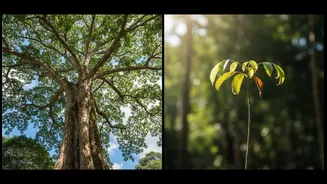
Recent studies are challenging the 'bigger is weaker' hypothesis. By examining trees before, during, and after severe droughts, scientists have found that taller trees do not necessarily suffer more or show greater declines in growth than their shorter neighbors. One study on giant dipterocarp trees in Malaysia, some towering over 230 feet, found no evidence that height made them more vulnerable during a major drought in 2023-2024. This surprising resilience points to a new conclusion: a tree's ability to survive drought is less about its height and more about the specific survival strategies embedded in its species' biology. These 'functional traits' are the anatomical and physiological characteristics that determine how a plant interacts with its environment. This means that a short tree with vulnerable traits could be at greater risk than a giant with robust adaptations. Understanding these traits is becoming critical for predicting which species and forests can withstand future climate pressures.
The Inner Workings: Hydraulic Adaptations
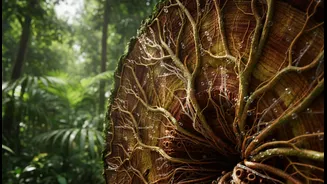
The secret to drought survival lies in a tree's internal plumbing. Some of the world’s tallest tropical trees have evolved sophisticated adaptations to defy gravity. Research shows that as they grow, they effectively re-engineer their own water transport systems. For instance, some giant trees produce wider xylem vessels near their base, which reduces resistance and allows water to flow more efficiently over long distances. Another key trait is wood density. Species with denser wood tend to have narrower water-conducting vessels, which are more resistant to forming the air bubbles that cause hydraulic failure. Other traits include the ability to store water in the trunk and the capacity to shed leaves during dry periods to conserve moisture. The leaves at the very top of tall trees can also be adapted to function with less water, effectively tolerating drier conditions. These findings show that many trees are not passive victims of their size but active engineers of their own survival.
Beyond the Trunk: A Whole-Plant Strategy
Drought resistance isn't determined by just one factor; it is a combination of traits working together. While wood density and xylem structure are crucial, so are the characteristics of leaves and roots. For example, a species' ability to control its stomata—the tiny pores on leaves that release water vapor—is a vital defense. Tighter stomatal control helps conserve water but can reduce photosynthesis. Leaf traits, like the ability to avoid wilting by maintaining cell turgor at lower water levels, are also strong predictors of drought tolerance. Below ground, root structure determines a tree’s ability to access deeper, more reliable water sources. The timing of the drought also matters. A study in Thailand found that some species are more sensitive to dry-season droughts, while others are more affected by droughts that extend into the wet season, showing that sensitivity is not a fixed characteristic. This complex interplay means that there is no single 'drought-proof' trait, but rather a spectrum of strategies that vary from one species to the next.
Implications for a Changing World
This shift from a size-based to a trait-based understanding of drought risk has profound implications. For one, it suggests some tropical forests may be more resilient to climate change than previously feared, as the tallest trees are not necessarily a weak link. However, it also complicates conservation efforts. Simply focusing on protecting the biggest, oldest trees may not be enough. To build resilient forests for the future, restoration projects should prioritize planting species with a diverse range of drought-tolerant traits, regardless of their ultimate size. As researchers have noted, a forest with high hydraulic diversity—meaning it contains species with many different water-use strategies—is likely to be more stable in the face of variable rainfall. For anyone studying ecology or concerned about the planet's future, the message is clear: to understand the forest, we must look past the canopy and into the biological blueprint of each species.