



Spotting the Movers
The first step in tracking a near-Earth object (NEO) is simply finding it. Telescopes take multiple images of the same patch of sky several minutes apart. Specialized software then compares these images, looking for any point of light that has moved against
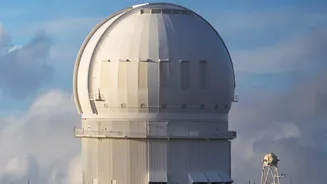
the fixed backdrop of distant stars and galaxies. Because asteroids are so much closer to us, their motion is detectable over these short timescales. Most initial detections are made by dedicated survey telescopes that systematically scan the sky for these faint, moving targets. Once a potential NEO is flagged, the race to define its path begins.
The Science of Astrometry
Finding a dot of light is one thing; knowing where it's going is another. This is the job of astrometry: the precise measurement of an object's position in the sky at a specific time. Astronomers need at least three separate observations to begin calculating a preliminary orbit. Each observation provides a data point—the asteroid's celestial coordinates (its 'address' in the sky) at that exact moment). These measurements must be incredibly precise. The data is then sent to a central global clearinghouse, the Minor Planet Center (MPC), which is officially sanctioned by the International Astronomical Union to collect this information.
From Data Points to a Path
The Minor Planet Center takes the observational data from telescopes worldwide and uses complex computer models to determine the object's orbital elements. These six key parameters—things like the orbit's size, shape, and tilt—uniquely define the asteroid's path around the sun. By applying the laws of celestial mechanics and gravity, scientists can plot this path. The MPC then compares this newly calculated orbit against its massive database of all known objects to see if it's a new discovery or a previously cataloged asteroid. This process transforms a few dots on a screen into a predictable trajectory through space.
Calculating the Risk
Once an orbit is established, it's projected into the future to see if it will intersect Earth's path. An asteroid is designated as 'Potentially Hazardous' (PHA) if its orbit brings it within 4.6 million miles (7.5 million kilometers) of Earth's orbit and it is larger than about 460 feet (140 meters) in diameter. This 'potentially hazardous' label doesn't mean it will hit Earth, only that it's large enough and comes close enough to warrant careful, continuous monitoring. Organizations like NASA's Center for Near-Earth Object Studies (CNEOS) use this data to continually assess impact risks for the next century.
The Need for More Observations
An initial orbit calculation is just the beginning. With only a few data points, the orbital path has a high degree of uncertainty. To shrink this uncertainty and predict an asteroid's future position with confidence, astronomers need more observations over weeks, months, or even years. Every new measurement from ground-based telescopes—whether from large professional observatories or skilled amateur astronomers—helps refine the orbit. This ongoing process is vital. It allows scientists to rule out potential impacts or, in a very rare case, provide an early warning if an object truly poses a threat, making these telescopes a critical part of our planetary defense strategy.