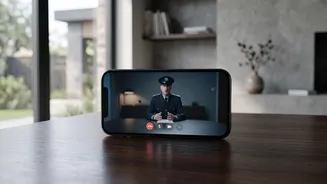










A call from the police is alarming. But what if it's a video call, with an 'officer' accusing you of a crime and placing you under 'digital arrest'? This terrifying scam is growing, but its power lies in one tool: cyber impersonation.
The Anatomy of a 'Digital Arrest' Scam
The script is distressingly
consistent. It begins with an unsolicited call, often from someone posing as an employee of a courier company like FedEx or a telecom provider. They claim a parcel in your name contains illegal items—like drugs or fake passports—or that your SIM card has been used for criminal activities. The call is then 'transferred' to a scammer impersonating a senior police or CBI official. This 'officer' escalates the situation, accusing you of serious crimes like money laundering or drug trafficking. To make the threat feel real, they initiate a video call on a platform like Skype, where you see them in a uniform, often in a mocked-up police station. They may even show a forged arrest warrant or FIR with your name and Aadhaar details, likely sourced from data breaches. This is when they declare you are under 'digital arrest', a legally non-existent concept. You are forbidden from disconnecting the call or speaking to anyone, effectively isolating you while they apply intense psychological pressure. The endgame is always to coerce you into transferring large sums of money to a 'government account' for 'verification', with the promise that it will clear your name.
The Real Weapon: Cyber Impersonation
The 'digital arrest' is merely the stage; the real weapon is sophisticated cyber impersonation. This isn't just a fake social media profile. It's a multi-layered deception where criminals pretend to be trusted individuals or entities to exploit human psychology. Scammers use technology to make their act believable. They can spoof phone numbers so the incoming call appears to be from a legitimate agency. They create fake but official-looking documents, ID cards, and arrest warrants. The impersonation extends to their environment, using police uniforms and fabricated backdrops to lend an air of authority during video calls. This tactic is a form of social engineering, designed to bypass your rational judgment by triggering fear and respect for authority. The scammers are not hacking your bank account directly; they are 'hacking' your trust by convincingly pretending to be someone they are not. By understanding that every element of their persona—the uniform, the documents, the authoritative tone—is a calculated part of the impersonation, you can begin to see the entire 'arrest' as the elaborate fraud it truly is.
Red Flags That Expose the Impersonation
Once you know to look for impersonation, the red flags become obvious. No legitimate law enforcement agency, including the police or CBI, will ever contact you via a standard phone or WhatsApp call to inform you of an arrest or ongoing investigation. They will never ask you to transfer money to 'resolve' a case or for 'verification' purposes. Any demand for payment is an immediate and definitive sign of a scam. Another major red flag is the element of secrecy and isolation. Scammers will insist that you do not speak to anyone else about the 'case', as this prevents you from getting a second opinion that would expose their fraud. A real investigation does not operate this way. Furthermore, be wary of anyone who asks you to stay on a video call for surveillance or interrogation. The very concept of a 'digital arrest' is a fabrication; it has no legal basis in India. Any mention of it is proof that you are dealing with a criminal.
Your Action Plan for Staying Safe
If you receive a call like this, your response should be swift and simple. First, disconnect the call immediately. Do not engage in arguments or try to prove your innocence to the caller. Second, never share any personal information, such as your Aadhaar number, bank details, or OTPs. Third, verify any claims independently. If the caller claimed to be from a specific police station, find that station's official number from a public directory and call them yourself. Do not use any contact information provided by the scammer. Finally, and most importantly, report the incident. For any financial cyber fraud, immediately call the National Cyber Crime Helpline at 1930. You should also file a formal complaint on the National Cyber Crime Reporting Portal at cybercrime.gov.in. Reporting quickly, especially within the first hour, can help authorities attempt to freeze the transferred funds.