




A Familiar Galaxy in a New Light
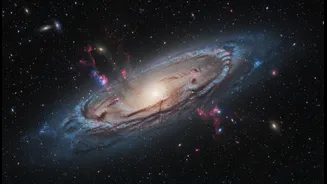
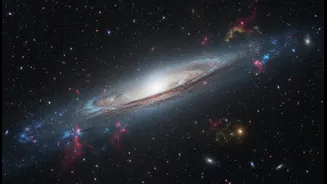
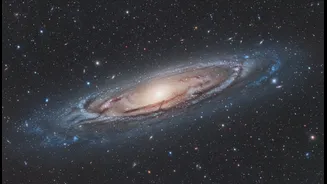
To mark four years of groundbreaking science, NASA has released a spectacular new image of Centaurus A, a galaxy relatively close to us at about 11 million light-years away. While this galaxy has been studied before by telescopes like Hubble and the retired
Spitzer Space Telescope, Webb’s new portrait is transformative. Its powerful infrared vision cuts through thick veils of cosmic dust that previously obscured our view, revealing the galaxy’s core with stunning clarity. What was once a hazy glow in older images is now a densely packed tapestry of millions of individual stars, each a point of light telling part of the galaxy's story.
Reading the Scars of a Cosmic Collision
Centaurus A is not a quiet, settled galaxy; it’s the site of a dramatic cosmic event. Its unusual, warped structure is the result of a collision with another galaxy that occurred roughly two billion years ago. This merger supplied the galaxy with a vast amount of gas and dust, triggering intense bursts of star formation that continue today. The new Webb image allows astronomers to perform a kind of galactic archaeology. By resolving individual stars, scientists can now start to build a clear timeline of the galaxy's evolution—distinguishing between the old stars that existed before the merger, the new stars born during the chaotic collision, and those formed in its aftermath.
A Dynamic and Hungry Black Hole
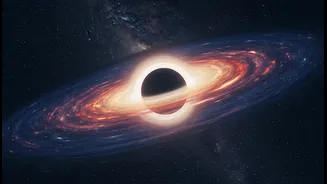
At the heart of Centaurus A lies an active supermassive black hole, furiously feeding on the material funneled toward it by the galactic merger. As it consumes gas and dust, the black hole blasts out powerful jets of energy that sculpt the entire galaxy. Webb's instruments can measure how gas moves within the galaxy's core, revealing new details about this complex relationship. Early findings show fast-moving ionized gas flowing outward, likely driven by the black hole, alongside a warped disk of rotating hydrogen gas near the center. This provides a rare, close-up view of how a central black hole can both trigger star formation by compressing gas and quench it by blowing that same material away.
Mysteries Revealed in the Dust
One of the most captivating aspects of the new image is the intricate structure of the dust itself. Webb's mid-infrared view highlights glowing, filamentary shapes that have surprised and puzzled astronomers. A peculiar, parallelogram-shaped band of dust cuts across the core, and a mysterious 'S'-shaped feature has also been spotted. Scientists are still working to understand what created these unusual formations. Are they relics of the ancient merger, or are they currently being shaped by the powerful influence of the central black hole? These perplexing new details showcase Webb's power not just to answer old questions, but to uncover entirely new ones that will drive the next phase of research.