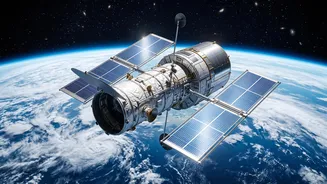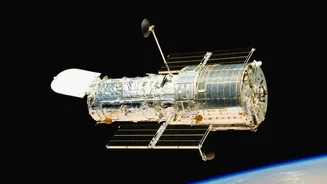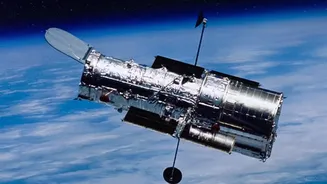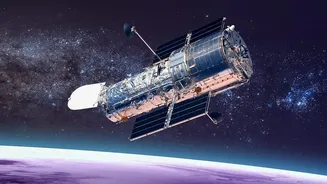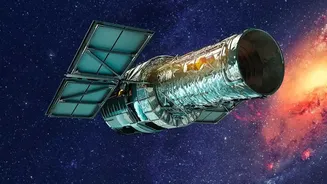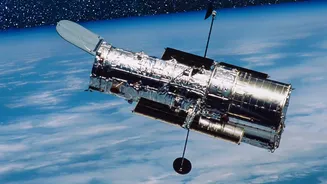



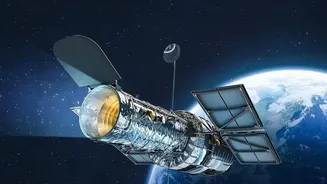
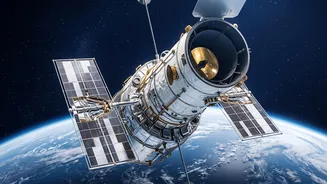
For over 35 years, the Hubble Space Telescope has been humanity's eye on the cosmos, delivering breathtaking images and revolutionary science. But a quiet, relentless force is pulling it back to Earth. Now, NASA is considering a novel approach to save
it.
The Slow, Inevitable Descent
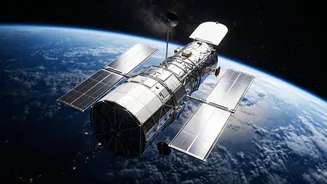
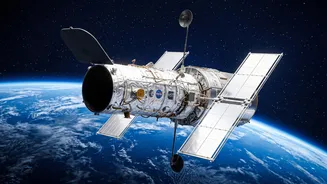
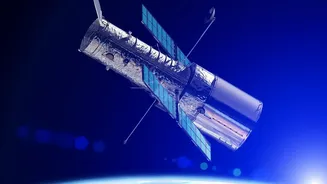
Like any object in low-Earth orbit, the Hubble Space Telescope is subject to atmospheric drag. Even hundreds of kilometres up, there are traces of Earth's atmosphere that create resistance, gradually slowing the telescope and causing its orbit to shrink. Since its last boost by a Space Shuttle mission in 2002, Hubble's altitude has been steadily decreasing. Unlike modern satellites, Hubble has no onboard propulsion system to counteract this decay. Current projections from NASA suggest that without intervention, the celebrated observatory could make a fiery, uncontrolled re-entry into the atmosphere sometime between 2033 and 2034. To prevent this, any rescue or reboost mission would need to happen before it descends too far, likely by 2032.
A New Business Model for an Old Icon
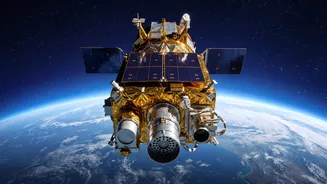
In the past, servicing Hubble was the exclusive domain of NASA's Space Shuttle program, involving complex and costly astronaut missions. With the shuttle fleet long retired, the agency is now looking towards a new model: public-private partnership. In late October 2026, NASA issued a formal Request for Information (RFI), inviting commercial space companies to propose their ideas and capabilities. This isn't a formal contract but a market study to see what's possible. The agency has outlined three main options: send a vehicle to push Hubble into a higher, more stable orbit; service it to enhance its scientific capabilities; or, as a last resort, guide it to a safe, controlled de-orbit. The move signals a major shift, framing the preservation of a legacy scientific asset as a new business opportunity for the burgeoning commercial space sector.
Who Could Answer the Call?
While the RFI is open to all, attention immediately turns to companies like SpaceX. In 2022, NASA and SpaceX conducted a joint, unfunded study to assess the feasibility of using a Dragon spacecraft for a reboost mission. That study was initiated in partnership with the Polaris Program, a private human spaceflight initiative funded by billionaire Jared Isaacman, who has since become the NASA Administrator. The Polaris study concluded that a reboost mission was technically feasible but did not move forward at the time. The new RFI in late 2026 reopens the door for SpaceX and other players to present detailed concepts, including launch vehicles, spacecraft designs, and mission plans—with or without crew. Responses are due by the end of November 2026, which will give NASA a clearer picture of the commercial appetite and readiness for such a complex undertaking.
More Than a Rescue Mission
Saving Hubble is about more than just preserving one telescope; it's a potential catalyst for an entire new sector of the space economy. A successful mission would pioneer the market for in-orbit servicing of satellites not originally designed for it. This could extend to repairing active satellites, refuelling them, or clearing hazardous space debris. While a recent attempt to rescue NASA's smaller Swift observatory by a commercial partner failed, it provided valuable lessons for future high-risk missions like this. The loss of Hubble would also create a significant gap in our astronomical capabilities. Its ability to observe in visible and ultraviolet light is not replicated by the newer James Webb Space Telescope, which primarily sees in the infrared. The next major observatory with similar capabilities, the Habitable Worlds Observatory, isn't planned until the 2040s, leaving a potential decade-long observational void.