




Why Safety Comes First
Before attempting a single-leg stand on a wobbly cushion, let's talk about why starting slowly and safely is non-negotiable. Improving balance isn't just about muscle; it's about training your nervous system. This involves a sense called proprioception,
which is your body's ability to know where it is in space without you having to look. Think of it as your internal GPS. When you start a balance routine, you're fine-tuning this system. Going too hard, too fast can lead to a fall, which not only risks injury but can also shatter your confidence. By prioritising safety, you create a positive feedback loop, allowing your brain and body to adapt, learn, and grow stronger together. Building this confidence is just as important as building physical strength.
Create Your Safe Zone
Your environment plays a huge role in the success of your balance practice. Before you begin any exercise, take a moment to set up a dedicated safe zone. This means clearing a space of any clutter, rugs, or obstacles you could trip over. It's best to perform your exercises on a firm, flat surface. Wear comfortable, non-slip shoes, or go barefoot if that feels more stable for you. Most importantly, position yourself near a sturdy wall, a countertop, or the back of a solid, heavy chair. This support is not a crutch; it's a smart tool. Use it to steady yourself as you find your footing, allowing you to focus on proper form without the fear of falling. Having this support nearby gives you the freedom to challenge yourself appropriately.
Foundational Exercises to Start
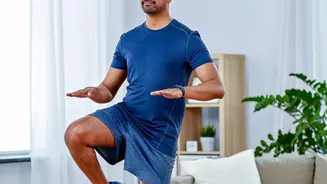
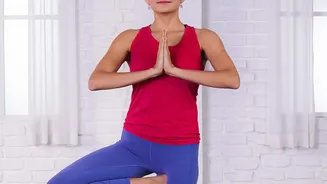
Complexity can wait. Mastery begins with the basics. Start with simple, static movements and aim for control and quality over quantity. Heel-to-Toe Walk: Imagine you're walking on a tightrope. Place the heel of one foot directly in front of the toes of your other foot. Take slow, deliberate steps. Use a wall for support if needed. Aim for 10-15 steps. Single-Leg Stand: This is a cornerstone of balance training. Stand tall and hold onto your support (a chair or wall). Shift your weight to one leg and slowly lift the other foot off the ground. Try to hold for 10-15 seconds, working your way up to 30 or even 60 seconds. Repeat on the other side. As you get more confident, you can progress from using two hands for support to one hand, then just a fingertip, and eventually no hands at all. Sit-to-Stand: Strong legs are crucial for good balance. Sit in a sturdy chair, then stand up without using your hands. Lower yourself back down with control. This simple movement builds essential strength in your glutes and quads.
Listen to Your Body
There's a difference between a healthy challenge and a risky push. Your body will give you signals—it's your job to listen. If you feel dizzy, sharp pain, or overly fatigued, it's time to stop and rest. Some muscle shakiness is normal as your body adjusts, but it shouldn't feel uncontrollable. The goal is to feel challenged but successful. If an exercise feels too easy, that's a sign you might be ready for a small progression. If it feels impossible and unsafe, scale it back. Consistency is far more important than intensity, especially in the beginning. Practicing for just 10-15 minutes a few times a week will yield better, safer results than one gruelling, risky session.
The Path to Progression
Once you've mastered the basic exercises and can perform them confidently without support, you can begin to slowly introduce more complexity. Progression should be gradual. Maybe you try a single-leg stand with your eyes closed for a few seconds (near your support!). Or you can introduce a slightly unstable surface, like a pillow or foam pad. You could also add small, controlled movements, like turning your head side-to-side while standing on one leg. These small changes continue to challenge your proprioceptive system, pushing it to adapt and improve. The key is to change only one variable at a time. Don't try to balance on an unstable surface with your eyes closed on your first attempt at progression. Think of it as a ladder—master each rung before reaching for the next.