

The Clockwork Illusion
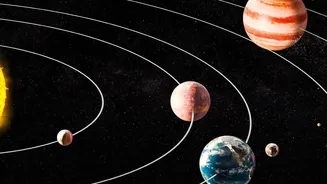
Since Isaac Newton, the prevailing image of our solar system has been one of magnificent, mathematical precision. The idea was simple: if you know the exact position and velocity of every planet, you can calculate their orbits forward or backward in time
with near-perfect certainty. This deterministic view suggested that the futures of Earth, Mars, Jupiter, and their neighbours were locked in, following a pre-written cosmic script. For decades, computer models were built on this principle, running one massive, complex calculation to map out a single, definitive future. However, scientists have long known that this is an oversimplification. The solar system isn't a simple two-body problem (like the Earth and Sun), but a chaotic 'N-body problem' where every object gravitationally tugs on every other object. These tiny, constant nudges can create massive, unpredictable changes over millions or billions of years.
Embracing a Thousand Futures
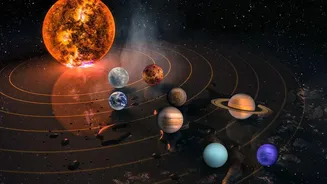
Instead of seeking one certain answer, a new approach in astrophysics runs hundreds, or even thousands, of simulations simultaneously. This is known as an 'ensemble' or 'probabilistic' simulation. Think of it like weather forecasting. A meteorologist doesn't just produce one single temperature for tomorrow; they run multiple models with slightly different starting conditions. If 90 out of 100 simulations show rain, there’s a 90% chance of rain. Astronomers are now doing the same for the planets. By making tiny, almost imperceptible tweaks to the initial starting positions of planets like Mercury or Jupiter, they can create a whole family of possible futures for the solar system. Running one simulation might show a stable system for billions of years. But running a thousand might reveal that in a small percentage of them, planetary orbits go haywire, leading to collisions or ejections from the solar system.
What These New Models Reveal
This statistical approach has already yielded startling insights. For a long time, the question of the solar system's long-term stability was an open question. Early ensemble simulations by researchers like Jacques Laskar showed that there's roughly a 1% chance that Mercury’s orbit could become highly erratic, potentially destabilising the inner planets over the next 5 billion years. More recent research has applied this method to the far future, when our Sun begins to die. Previous models assumed the Sun would lose mass smoothly. But new studies simulate the Sun losing mass in uneven, violent bursts. One study ran 672 simulations of this process. It found that while previous estimates saw the outer planets' orbits remaining stable for up to 100 billion years, the new, more chaotic model shows the system could fall apart within just one billion years after the Sun becomes a white dwarf — a timeframe a billion times shorter than some older predictions.
A Chaotic but Clearer Picture
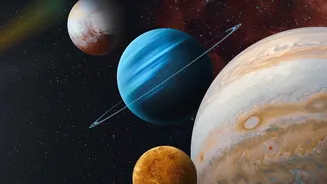
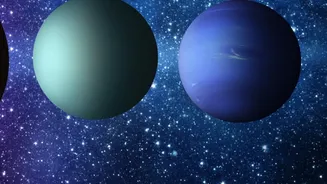
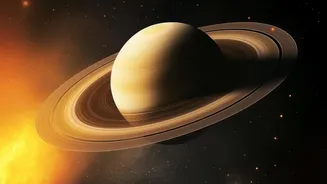
In these simulations of the Sun's death throes, about 40% of the scenarios lead to major disruptions before the Sun even fully becomes a white dwarf. The results can be dramatic: Saturn gets ejected from the solar system entirely, or Uranus and Neptune swap their orbital positions. This doesn't mean it will happen, but that it's a significant possibility within the realm of physics. This shift from a deterministic to a probabilistic model doesn't mean our understanding is getting worse; it means it's getting more honest and realistic. It acknowledges that chaos is a fundamental part of our cosmic neighbourhood. Knowing there's a 1% chance of a planetary collision is far more useful than having a single, likely incorrect, model that shows perfect stability forever. It allows scientists to quantify uncertainty and focus on the most sensitive and potentially dangerous variables in our system's delicate dance.