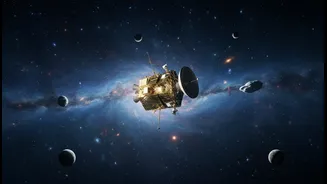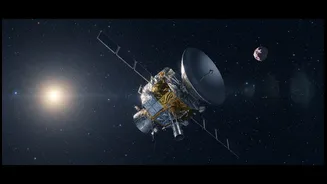





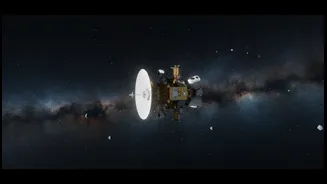
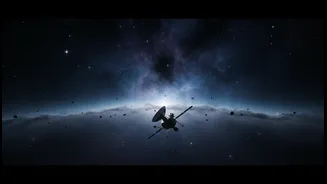


The Longest Nap
On June 23, 2026, flight controllers at the Johns Hopkins Applied Physics Laboratory confirmed they had received a signal from New Horizons. The message, which took nearly nine hours to cross the vast distance to Earth, reported that the spacecraft had successfully
executed commands sent last year to wake from a prolonged state of hibernation that began in August 2025. This power-saving measure is crucial for long-duration missions. While most of its systems were unpowered, several key instruments continued to collect data around the clock, passively sensing the strange environment of the Kuiper Belt. Mission Operations Manager Alice Bowman confirmed that weekly status reports during the hibernation were all 'green', indicating the probe remained in perfect health throughout its slumber.
A History-Making Explorer
It’s easy to forget just how revolutionary the New Horizons mission has been. Launched in 2006, it completed the initial reconnaissance of the classical planets when it flew past Pluto in 2015. The data it sent back transformed our understanding of the dwarf planet, revealing a world with active geology, vast nitrogen-ice glaciers, and hints of a subsurface ocean. But it didn't stop there. On New Year's Day 2019, New Horizons flew past Arrokoth, the most distant and primitive object ever explored by a spacecraft. This encounter gave scientists their first close-up look at a building block of the solar system, a relic preserved in the deep freeze of space for billions of years.
An Observatory at the Edge of the System
With no new flyby targets currently in its path, the mission has shifted its focus. New Horizons is now acting as a unique, moving observatory in a region of space no other active mission is exploring. Its current tasks are just as vital as its past flybys. The spacecraft is using its instruments to study the heliosphere, the vast bubble of charged particles blown outward from the sun. It measures the solar wind and the dust environment, providing crucial data on the boundary between our solar system and interstellar space. In fact, recent data has shown higher-than-expected dust levels, suggesting the Kuiper Belt may be even larger than previously thought. In the coming weeks, it will begin observing the distribution of hydrogen gas at this distant frontier.
A Race Against a Fading Light
Despite its success, the mission faces an unavoidable deadline. New Horizons is powered by a Radioisotope Thermoelectric Generator (RTG), which creates electricity from the heat of decaying plutonium. This power source is incredibly reliable but its output steadily decreases over time. While engineers believe the spacecraft has enough power and fuel to continue operating into the 2040s, the search for a potential third Kuiper Belt Object to visit is on. The team is using powerful ground-based observatories to scan the skies ahead of the probe, hoping to find a reachable target before the spacecraft's power dwindles too much to perform another complex flyby. It is a quiet race against time, pushing the limits of both the spacecraft and our ability to see into the dark.