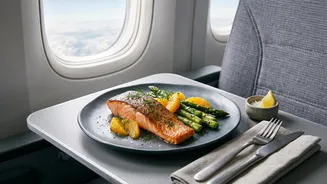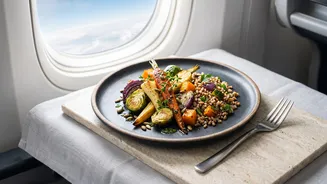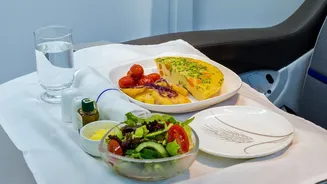








Have you ever noticed how many people order tomato juice on a flight? It’s a drink many of us rarely touch on the ground, yet at 35,000 feet, it suddenly becomes a top request. This isn't just a coincidence; it's a fascinating trick of science.
The Hostile Environment for Flavor
An airplane
cabin is a tough place for your senses. At cruising altitude, the cabin is pressurized to the equivalent of being on a mountain top, around 6,000 to 8,000 feet high. This low pressure, combined with extremely low humidity levels—often below 12-20%, drier than a desert—wreaks havoc on your ability to taste and smell. Your nasal passages dry out, and since your sense of smell is responsible for about 80% of what you perceive as flavor, food and drinks can start to taste incredibly bland. It’s a similar feeling to having a bad cold, where everything seems dull.
Sweet and Salty Tastes Get Muted
Scientific studies, including landmark research commissioned by German airline Lufthansa, have confirmed this sensory suppression. Using a simulated aircraft cabin, researchers found that under flight conditions, our perception of sweet and salty flavors drops by as much as 20–30%. This is why that dessert might not seem sweet enough or the pretzels taste under-salted. The low pressure and dry air numb the specific taste receptors responsible for these flavors, leaving many in-flight meals tasting flat. Add in the constant drone of the engines, often around 85 decibels, and the effect is compounded. Studies have shown this background noise further suppresses sweet notes.
Umami: The Fifth Taste's Superpower
While sweet and salty flavors fade, another taste profile holds its ground: umami. Often described as a savory, rich, or meaty flavor, umami is known as the 'fifth taste'. It's found in foods like mushrooms, aged cheeses, and, most importantly, tomatoes. Research from institutions like Germany's Fraunhofer Institute and Cornell University has shown that our ability to perceive umami is largely unaffected by the low pressure and humidity of a flight. In fact, some studies suggest the loud background noise of the engines can even enhance our perception of it.
Tomato Juice to the Rescue
This brings us back to that humble glass of tomato juice. On the ground, it can have a prominent earthy, sometimes musty, taste. But in the air, everything changes. Because your sensitivity to sweet and salty tastes is diminished, the other flavors in the juice come forward. Tomatoes are packed with glutamates, the compounds that trigger our umami receptors. At altitude, the juice's savory, umami character cuts through the sensory dullness, tasting fresher, more acidic, and more mineralic than it does on land. Its inherent acidity also helps refresh a dry palate. Suddenly, the drink that seemed unappealing on the ground becomes perfectly balanced and satisfying in the sky.
A Well-Known Secret Among Airlines
Airlines have been aware of this phenomenon for years. Lufthansa, for example, noted it was serving over 1.5 million litres of tomato juice annually, a volume nearly matching its beer consumption. This observation is what prompted their scientific investigation in the first place. The popularity is so entrenched that when United Airlines once tried to remove tomato juice from its shorthaul flight menu, the public outcry was so swift and strong that the airline quickly reversed its decision. It has become a comforting and expected ritual of air travel, all thanks to the unique way our bodies react to the environment at 35,000 feet.