






Dune (2021)
Denis Villeneuve’s adaptation of the supposedly 'unfilmable' novel is a masterclass in scale. Everything in 'Dune' is designed to feel overwhelmingly large, from the colossal sandworms churning through the desert to the monolithic, brutalist architecture
of Arrakeen. The visual effects team, who also worked on 'Blade Runner 2049', focused on photorealism, blending practical effects and CGI to make the world feel tangible and weathered. Instead of traditional green screens, they often used 'sandscreens'—massive backdrops matching the colour of the sand—to ensure the lighting on the actors was perfectly integrated with the digital environments of the desert planet. This created a sense of grounded reality, making the impossibly huge spaceships and epic battles feel frighteningly real.
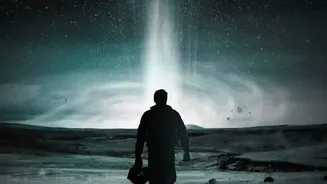
Interstellar (2014)
Christopher Nolan is known for his commitment to practical effects, and 'Interstellar' took that philosophy to the cosmos. For the film's depiction of a black hole, Gargantua, Nolan collaborated with theoretical physicist Kip Thorne to ensure scientific accuracy. The visual effects team developed a new rendering software that translated Thorne's complex equations into a visual representation of gravitational lensing. The result was not only one of the most iconic images in modern cinema but also led to the publication of two scientific papers. Many frames of the black hole sequence took up to 100 hours to render, showcasing a dedication to scientific and visual authenticity that paid off with a truly mind-bending cinematic experience.
Blade Runner 2049 (2017)
A sequel to a visual masterpiece, 'Blade Runner 2049' had enormous shoes to fill, and it succeeded spectacularly. Director Denis Villeneuve and legendary cinematographer Roger Deakins created a dystopian future that is both breathtakingly beautiful and hauntingly bleak. Deakins, who finally won his first Oscar for this film after 14 nominations, painted each frame with incredible light and colour. From the hazy, orange glow of a post-apocalyptic Las Vegas to the rain-slicked, neon-drenched streets of Los Angeles, the film is an unforgettable visual symphony. The blend of miniature models and digital effects gave the cityscapes a sense of tactile reality, making the world feel expansive and lived-in, a worthy successor to the original's groundbreaking aesthetic.
Gravity (2013)
Few films have captured the terrifying beauty and isolation of space like Alfonso Cuarón’s 'Gravity'. The film is a technical marvel, winning seven Oscars, including for its groundbreaking visual effects. To simulate the weightlessness of space, the filmmakers developed new technology, including a 'Light Box'—a massive cube lined with LED screens that could project images onto the actors, creating realistic lighting and reflections. In most shots, the only real element on screen was the actors' faces inside their helmets; everything else, from the space suits to the International Space Station and the Earth below, was computer-generated. The film’s famous opening shot, an uninterrupted 13-minute sequence, immerses the audience completely, making them feel every heart-pounding moment of the characters' struggle for survival.
2001: A Space Odyssey (1968)
No list of visually stunning sci-fi is complete without Stanley Kubrick’s monumental achievement. Made decades before modern CGI, '2001' set the standard for cinematic spectacle through meticulous and innovative practical effects. To create the illusion of artificial gravity, the production built a massive, 30-ton rotating centrifuge set that cost a significant portion of the film's budget. The iconic 'Star Gate' sequence was achieved using a novel technique called slit-scan photography, which involved moving a camera towards artwork at a slow speed to create a psychedelic vortex of light and colour. Kubrick’s relentless perfectionism ensured that every shot was as realistic as possible, creating a vision of the future that remains astonishingly powerful and believable today.