


An Enduring Cosmic Riddle
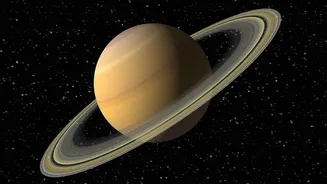
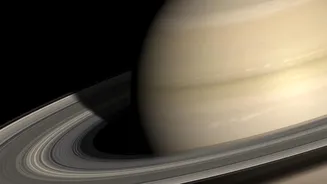
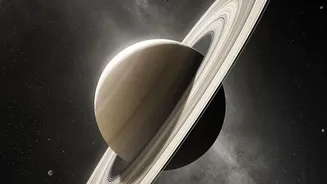
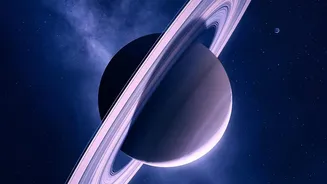
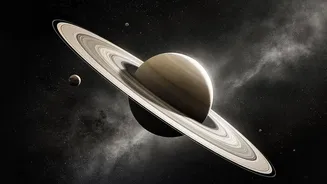
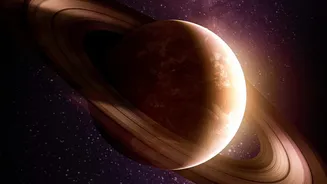
From the moment Galileo first observed them in 1610, Saturn's rings have captivated astronomers. We now know they are a vast, complex system composed of countless chunks of water ice, ranging in size from tiny grains to massive, mountain-sized blocks.
But the central question has always been: where did they come from? For a long time, the assumption was that the rings were primordial, forming alongside Saturn itself around 4.5 billion years ago. However, this idea has been challenged by mounting evidence suggesting they are far too pristine and bright to be that old. Over billions of years, they should have been darkened and polluted by a constant rain of micrometeoroid dust. This discrepancy has created one of planetary science's most compelling debates.
Clues from a Grand Finale
The game-changing data came from NASA's Cassini spacecraft, which orbited Saturn from 2004 to 2017. During its daring "Grand Finale" dives between the planet and its rings, Cassini made crucial measurements. It determined the mass of the rings and measured the rate at which ring material is raining down onto Saturn. This "ring rain" is so significant—many tons per second—that it implies the rings are a temporary feature, destined to disappear in just a few hundred million years. This finding strongly supports the theory that the rings are young, perhaps only a few hundred million years old, meaning they likely formed when dinosaurs roamed the Earth.
A Tale of Two Theories
The evidence for young rings has given rise to a dramatic origin story. The leading theory today is that the rings are the result of a cosmic catastrophe that occurred relatively recently. Computer simulations suggest that two of Saturn's icy moons may have collided, shattering into a cloud of debris. Another version of this theory proposes that a single large moon, nicknamed "Chrysalis," strayed too close to Saturn and was torn apart by the planet's immense gravity. Such an event would naturally explain why the rings are almost entirely pure ice; the rocky cores of the destroyed moon or moons would have been less widely dispersed than their icy mantles. While the young-ring theory is popular, some scientists still argue for an ancient origin, suggesting that processes we don't fully understand could be keeping the rings clean, making them appear younger than they are.
The Need for a New Look
While Cassini provided a treasure trove of information, it wasn't designed to definitively solve the age and origin mystery. It observed from orbit, but to truly understand the rings' history, scientists need to get their hands on the material itself. Measuring the precise ratio of rocky pollutants to pure ice in the ring particles is key. The amount of dust accumulated acts like a cosmic clock; the more dust, the older the rings must be. To settle the debate, a future mission needs to do something Cassini never could: directly sample the ring particles. Only by analyzing this material up close can we be sure of its composition and, therefore, its age.
Touching the Rings with PRAXIS
To that end, NASA is exploring ambitious new concepts. One of the most exciting is a proposed mission called PRAXIS (Planetary Rings Autonomous EXploration with In-situ Sampling). This AI-powered robotic explorer would be the first spacecraft to ever physically "touch" the rings. PRAXIS would use a long robotic boom to perform a delicate 'touch-and-go' maneuver, collecting tiny particles without risking a collision in the fast-moving ring environment. These samples would then be analyzed onboard, providing direct measurements of their composition. Though still in the early concept phase, PRAXIS represents a major step toward obtaining the ground-truth data needed to solve the ring mystery once and for all.