




The Old Way: The Limits of Radio Waves
For as long as humans have sent probes to other planets, we have relied on radio frequency (RF) communications to stay in touch. It’s a proven, reliable method, but it has its limits. Think of a radio signal like the beam of a wide flashlight. As it travels
millions of miles from Mars or beyond, the beam spreads out, becoming weaker and more diffuse. By the time it reaches Earth, only a tiny fraction of the original signal is captured by our large radio antennas. This means data transmission is slow. For instance, it can take hours for a high-resolution image from the Mars Reconnaissance Orbiter to be fully downloaded. For future missions, especially those involving humans, sending back streams of high-definition video or massive scientific datasets requires a much bigger 'pipe'.
The New Frontier: A Focused Beam of Light
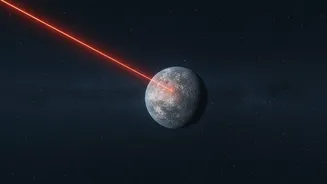
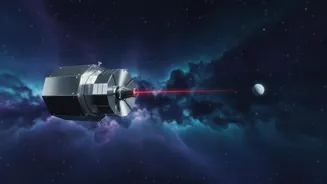
Laser communications, also known as optical communications, represent a fundamental shift. Instead of a wide-beam flashlight, imagine a sharply focused laser pointer. These systems encode data onto beams of near-infrared light—invisible to the human eye but perfect for carrying information. Because the wavelength of light is much shorter than radio waves, the data can be packed in much more tightly. This allows laser communication systems to transmit 10 to 100 times more data than the best radio systems currently in use. This leap in bandwidth is what makes streaming HD video from deep space a reality instead of science fiction.
How It Works: Encoding Data on Photons
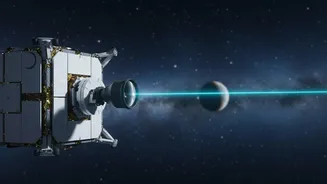
The process is conceptually simple, but the engineering is extraordinary. A transceiver on a spacecraft, like the one on NASA's Psyche mission, uses a laser to fire off rapid pulses of light. These pulses are encoded with digital data, turning ones and zeros into flashes of photons. This narrow beam is aimed with incredible precision at a target on Earth that is constantly moving. To ensure the spacecraft hits its mark, a ground station on Earth first sends up a laser 'beacon' of its own. The spacecraft locks onto this beacon and uses it to perfectly aim its data-carrying downlink beam. On the ground, massive telescopes, like the Hale Telescope at Palomar Observatory, act as receivers. They collect the faint photons that have traveled millions of miles and use highly sensitive superconducting detectors to decode the information they carry.
A Landmark Test: The DSOC Experiment
This technology isn't just theoretical. NASA’s Deep Space Optical Communications (DSOC) experiment, flying aboard the Psyche spacecraft, has been proving its capabilities since late 2023. In one of its most famous tests, DSOC streamed a 15-second, ultra-high-definition video of a cat named Taters from 19 million miles away. The video was transmitted at a maximum rate of 267 megabits per second (Mbps), a speed comparable to many home broadband connections. The experiment has continued to break records, successfully transmitting engineering data from over 140 million miles away at 25 Mbps—a rate far exceeding what was thought possible at that distance.
Why It's a Game-Changer for Exploration
The implications of this technology are enormous. Faster data rates mean scientists can get more science back from their instruments. Instead of waiting weeks to build a map of Mars, it could be done in days. For future human missions to Mars, it means reliable, high-definition video links with Earth, which are crucial for astronaut health, morale, and mission operations. Furthermore, laser communication hardware is generally smaller, lighter, and requires less power than comparable radio systems. This frees up valuable mass and power on a spacecraft for more scientific instruments or other critical systems, ultimately making missions more efficient and capable.