





The Truth Behind the Hype
When you hear “NASA” and “hidden planet” in the same sentence, your mind might jump to Planet 9, the hypothetical giant lurking at the edge of our solar system. For years, astronomers have debated its existence, pointing to the strange orbits of distant
icy objects as evidence. But the latest buzz isn't about a new neighbor. Instead, it’s about a world thousands of light-years away, revealed not by a new telescope pointed at the sky, but by a clever new way of looking at old information. The “hidden planet” wasn’t concealed behind an asteroid belt; it was buried in data archives, waiting for the right eyes and the right technique to bring it into view. This discovery is less about finding a single object and more about unlocking a powerful new method for cosmic exploration.
Einstein's Cosmic Magnifying Glass
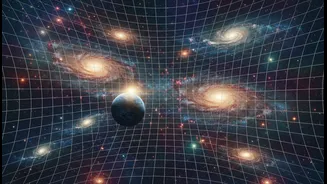
The planet, named Gaia23bra b, was found using a phenomenon Albert Einstein predicted over a century ago: gravitational microlensing. In simple terms, gravity bends light. When a massive object like a star and its planet passes in front of another, more distant star, its gravitational field acts like a magnifying glass. It briefly makes the background star appear brighter. NASA's TESS satellite, which typically finds planets by watching for the dimming of a star as a planet transits in front of it, was taught a new trick. Scientists sifted through its data to spot the opposite effect: a telltale brightening caused by a microlensing event. This technique is especially powerful for finding planets that are too far from their star or too distant from Earth to be detected by the traditional transit method.
Meet the Newly Uncovered World
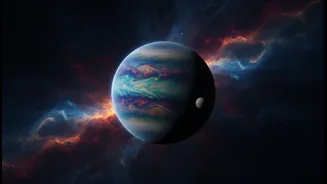
So what exactly did they find? Gaia23bra b is a behemoth, a gas giant about 1.6 times the mass of Jupiter. It orbits an orange dwarf star, roughly 80% the size of our sun, at a distance similar to Jupiter's orbit. This kind of planet—a large world on a wide orbit—is extremely difficult for a telescope like TESS to find with its usual methods, which are best suited for spotting large planets orbiting very close to their stars. What makes this find even more remarkable is its distance. The planetary system is located an incredible 40,000 light-years away. TESS usually discovers planets within a radius of about 150 light-years, making Gaia23bra b an exceptionally remote discovery for this particular satellite.
Finding a Signal in the Noise
The first clue about this planet didn't even come from TESS. In 2023, the European Space Agency's now-retired Gaia telescope flagged a star that was brightening, a potential microlensing event. However, Gaia's observations were too infrequent to confirm a planet was involved. That’s where TESS came in. Researchers realized that TESS had also been monitoring that same patch of sky with much more frequency. By digging back into those archived observations—the data that had already been collected and stored—they found the detailed light curve they needed. The data showed the primary brightening from the star, plus a smaller, secondary blip caused by the planet itself, confirming its existence. As one researcher noted, no one expected TESS to be capable of finding this kind of planet when it launched.
A New Frontier in Planet Hunting
This discovery does more than just add one more exoplanet to the catalog, which has already swelled to over 6,000 confirmed worlds. It proves that a wealth of discoveries may be lying dormant in existing data, just waiting for new analytical tools. The success with Gaia23bra b implies that many more microlensing planets could be hiding in TESS's vast archives. This is also a preview of what's to come. NASA's next-generation Nancy Grace Roman Space Telescope, set to launch in 2026, will use microlensing as one of its primary detection methods. It is expected to find thousands of new exoplanets this way, scanning the dense star fields at the heart of the Milky Way. This single discovery has opened a new door, turning our existing observatories into even more powerful discovery machines.