





An Accidental Discovery in an Ancient Canyon
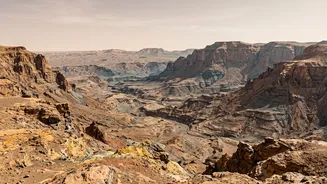
In a moment of scientific serendipity, NASA's Curiosity rover made an unexpected finding while traversing Gediz Vallis, a channel carved into the side of the 5-kilometre-high Mount Sharp. In May 2024, the nearly 900-kilogram rover drove over a seemingly
ordinary rock, cracking it open like an eggshell. What its cameras revealed inside was startling: bright yellow crystals glistening against the dark Martian dust. This wasn't the usual reddish rock or soil. Using its onboard instruments, including the Alpha Particle X-ray Spectrometer (APXS), the science team confirmed the material was pure elemental sulfur. While Mars is known to be rich in sulfates—minerals where sulfur is bound with oxygen and left behind by evaporating water—this was the first time raw, unbound sulfur had been confirmed on the planet. The discovery didn't stop with one rock; the rover found an entire field of these sulfurous stones scattered across roughly 2,100 square metres.
The Puzzle of Pure Sulfur
The existence of pure sulfur presented a significant puzzle for scientists. On Earth, large deposits of elemental sulfur are typically formed by processes involving intense heat, such as volcanic activity or hydrothermal vents. However, the geological context of Gediz Vallis showed no obvious signs of such high-temperature events. This left researchers to wonder how so much pure sulfur could have formed and remained preserved in this specific location. The finding was described by Curiosity's project scientist, Ashwin Vasavada, as being like 'finding an oasis in the desert', something that shouldn't be there and demanded an explanation. Two recent studies have proposed new theories that don't require extreme heat or biological activity, opening new windows into Mars' complex past.
Reading the Clues: Two New Theories
One leading theory suggests the sulfur originated from volcanic gases released billions of years ago. These sulfur-bearing gases could have become trapped under the surface, possibly within ice structures. Later, as powerful flows of water and debris carved out the Gediz Vallis channel, the pressure was released, allowing the gases to escape and react chemically to form solid, pure sulfur without needing high heat at the site. Another study showed through lab experiments that pure sulfur crystals could form at room temperature in acidic water if specific chemical compounds, like dissolved sulfide and chlorate, were present. Both theories provide non-biological pathways for the sulfur's formation, suggesting a more complex and dynamic Martian geology than previously understood.
Gediz Vallis: A Window into a Wetter Mars
The location of the discovery is just as important as the discovery itself. Gediz Vallis is a winding channel in the foothills of Mount Sharp, a mountain Curiosity has been climbing since 2014. Scientists believe the channel was formed by massive debris flows, where water carried rocks and sediment down the mountainside. This makes the boulders and deposits within the canyon some of the youngest evidence of liquid water that Curiosity is likely to study on Mount Sharp. By examining these materials, which were washed down from higher, unreachable elevations, scientists are getting a glimpse into a later period of Martian history—a time when the planet's climate was transitioning and water was beginning to disappear. The abundant sulfates found throughout the region are powerful evidence of this past water activity, as these salts are left behind when water evaporates. These sulfate deposits are excellent at preserving potential chemical signs of past life, making them a prime target for astrobiology.