






An Orbital Junkyard
For decades, we have been launching objects into space, and we've left a lot of mess behind. There are now over 130 million pieces of human-made debris in orbit, ranging from tiny paint flecks to entire defunct satellites and spent rocket stages. These
objects travel at speeds up to 28,000 kilometres per hour. At that velocity, even a small object can cause catastrophic damage to an operational satellite or a crewed spacecraft. The bigger concern is a chain reaction scenario known as the Kessler Syndrome, where collisions create more debris, leading to more collisions, potentially making parts of Earth's orbit unusable for generations.
The Challenge of a Cosmic Cleanup
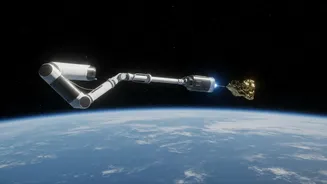
Cleaning up this high-speed garbage is incredibly difficult. Various methods have been proposed and tested, including giant nets, harpoons, and even robotic arms to grab and de-orbit junk. While innovative, these 'contact' methods have significant drawbacks. Capturing a large, heavy object that is tumbling uncontrollably is a high-risk manoeuvre. A failed attempt could damage the cleanup craft or, even worse, create a fresh cloud of even smaller, harder-to-track debris. The complexity and risk involved have slowed the deployment of a large-scale solution, leaving the orbital environment increasingly cluttered.
Enter the Magnetic Tether
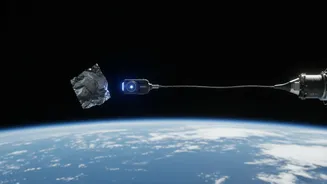
This is where magnetic capture offers a genuine breakthrough. Instead of trying to physically grab a piece of debris, this method uses powerful magnetic forces to influence it from a safe distance. The primary technology is the electrodynamic tether, a long, conductive cable that can be thousands of metres long. When a current is passed through this tether, it interacts with Earth's magnetic field, generating a force called the Lorentz force. This force can be used to create drag, pulling a captured object down into the atmosphere to burn up, without using any propellant. This makes the system lighter, more efficient, and capable of performing many removals.
A Breakthrough in Safety and Efficiency
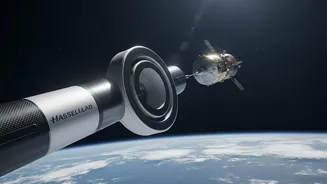
The real game-changer is the 'contactless' nature of the capture. A 'chaser' satellite equipped with strong electromagnets can approach a piece of debris and use magnetic fields to gently slow its rotation and then tow it without ever touching it. This dramatically reduces the risk of impact and fragmentation. This method works by inducing eddy currents in the metallic body of the debris, creating a magnetic braking and pulling effect. Furthermore, many existing satellites already have components called magnetorquers for orientation, which a magnetic tug could latch onto, making it possible to de-orbit them even if they weren't designed with a capture plate. Companies like Astroscale have already successfully demonstrated magnetic docking in orbit, proving the concept is viable.
The Future of a Cleaner Orbit
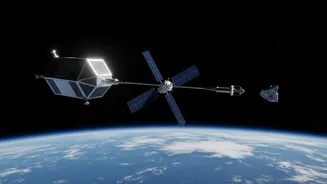
While the technology is incredibly promising, it's not yet a universal solution. It works best on objects with sufficient metallic and conductive mass. But as a key part of a broader cleanup strategy, it's a massive step forward. Active development is underway by both private companies and space agencies like ESA and JAXA. Some proposals envision small fleets of reusable magnetic tugs that could methodically clear the most crowded orbits. The long-term vision is twofold: using these systems for active debris removal, and equipping future satellites with simple docking plates to make their eventual removal easy and low-cost. This ensures that as we continue to explore and utilise space, we do so sustainably.