

Why Infrared Is the Key
When trying to study a distant exoplanet, astronomers face a major hurdle: the blinding glare of its host star. The star is millions or billions of times brighter than the planet orbiting it, making the planet incredibly difficult to see directly. This
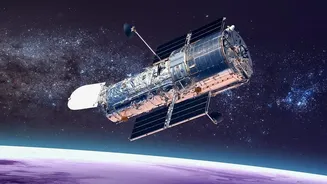
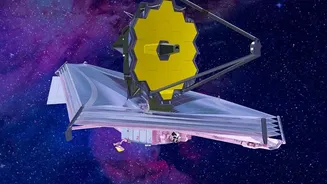
is where infrared light becomes a game-changer. While a planet reflects very little visible light, it often emits its own heat as infrared radiation. Advanced observatories, most notably the James Webb Space Telescope (JWST), are specifically designed to be highly sensitive to this infrared light. This allows them to either detect the planet's faint glow directly or, more commonly, to analyze the starlight that has been altered by the planet's atmosphere. This capability has completely transformed our ability to probe the conditions on these alien worlds.
The Shadow Play: Transmission Spectroscopy
One of the most powerful techniques for atmospheric study is called transmission spectroscopy. It works when a planet passes in front of its star from our point of view, an event known as a transit. As the starlight filters through the rim of the planet's atmosphere, different molecules and atoms absorb specific wavelengths, or colors, of light. Think of it like shining a white light through a colored filter—the light that comes out has certain colors missing. By capturing the star's spectrum of light before and during the transit, astronomers can see exactly which wavelengths were absorbed by the planet's atmosphere. Since every chemical, like water vapor, methane, or carbon dioxide, has a unique spectral 'fingerprint,' this method allows scientists to create a detailed list of the atmospheric ingredients of a world hundreds of light-years away.
Capturing a Planet's Glow: Emission Spectroscopy
While transmission spectroscopy tells us about the edge of the atmosphere, emission spectroscopy gives us a direct look at the planet's dayside. This method involves measuring the combined light of the star and planet, and then measuring the light of just the star when the planet moves behind it in a 'secondary eclipse'. By subtracting the star's light from the combined total, astronomers are left with the light coming directly from the planet itself. This emitted light, primarily in the infrared, reveals the planet's temperature at different atmospheric layers. Hotter planets glow more brightly, and the specific wavelengths of light they emit provide clues about their chemical composition and thermal structure, revealing whether certain layers are hotter or cooler than expected.
Mapping Weather on Alien Worlds
Perhaps the most ambitious technique is creating 'phase curves'. This involves monitoring the total brightness of a star-planet system continuously as the planet completes an entire orbit. For planets orbiting very close to their star, they are often tidally locked, with one side perpetually facing the star (dayside) and one side facing away (nightside). As the planet orbits, we see different phases, much like our own Moon. By measuring the subtle changes in infrared brightness, scientists can map the temperature across the planet's surface from east to west. These maps can reveal the hottest and coldest spots, suggesting the presence of powerful winds moving heat from the scorching dayside to the cooler nightside. For the exoplanet WASP-43b, JWST data was used to create a weather map suggesting clear skies on its dayside, thick clouds on the nightside, and ferocious equatorial winds.
The Power of the James Webb Space Telescope
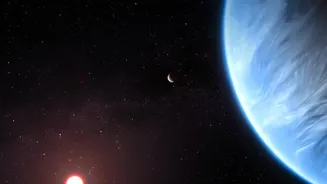
The launch of the James Webb Space Telescope (JWST) has revolutionized the study of exoplanet atmospheres. Its large mirror and advanced infrared spectrographs provide unprecedented sensitivity and precision. JWST has already delivered groundbreaking results, making the first unambiguous detection of carbon dioxide in an exoplanet's atmosphere on the 'hot Saturn' WASP-39 b. It also found surprising signs of active chemistry on the same planet, detecting sulfur dioxide, which is likely created by the star's high-energy light interacting with the atmosphere. The telescope has even detected water vapor, methane, and potential biosignatures on planets like K2-18b, and has observed planets violently shedding their atmospheres into space. These observations are pushing the boundaries of what we thought was possible, turning points of light in the sky into complex worlds we can begin to understand.