



The Ultimate Ejection Seat
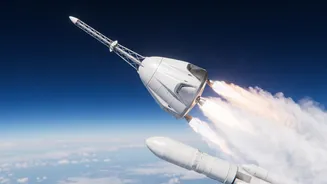
Think of the Crew Escape System (CES) as the most advanced ejection seat ever built. Its sole purpose is to pull the Crew Module—the capsule carrying the astronauts—away from the launch vehicle in case of a catastrophic failure on the launchpad or during
ascent. This system must react in milliseconds, firing powerful, quick-acting solid-fuel motors to rapidly distance the crew from danger. The goal is simple but critical: to ensure the astronauts can be brought back to safety even if the rocket underneath them experiences a major malfunction. It's a technology that only a handful of nations have mastered, and it's a cornerstone of the entire Gaganyaan programme.
Anatomy of an Escape
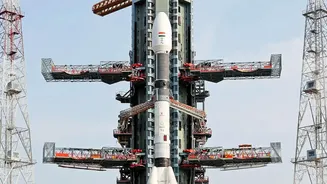
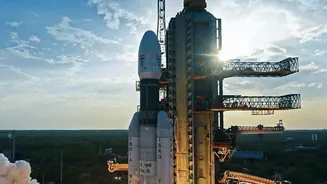
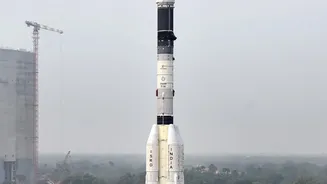
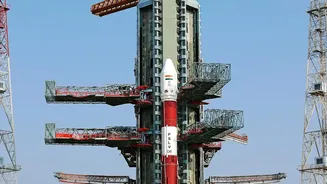
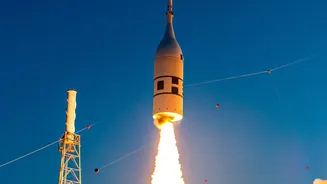
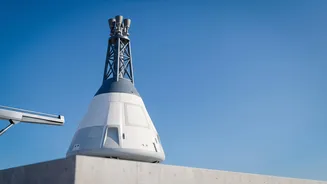
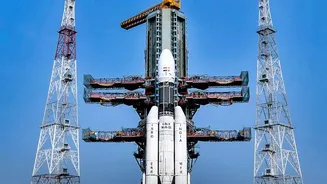
The Gaganyaan CES is a complex assembly mounted on top of the Crew Module, giving the rocket its characteristic pointed tip. This 'escape tower' is composed of several solid-propellant motors. Key among them are high-altitude escape motors and pitch motors. When an abort is triggered, the system ignites to generate immense thrust, pulling the capsule clear. This action is designed to be powerful enough to outrun an exploding launch vehicle, subjecting the crew to high but survivable G-forces. The system's onboard computers constantly monitor the launch vehicle's health, ready to initiate an abort automatically if any parameters go off-nominal, such as a loss of thrust or a dangerous deviation in trajectory.
Abort Scenarios: From Pad to Sky
An emergency can happen at any moment, and the CES is designed to handle multiple scenarios. A 'Pad Abort' occurs if there's a problem before or during liftoff. Here, the CES would fire to lift the Crew Module up and away from the launch pad, before deploying parachutes for a safe landing nearby. More complex is an 'in-flight abort'. The most challenging phase of a launch is often during transonic flight, when the vehicle passes the speed of sound and experiences maximum aerodynamic pressure. An abort at this stage requires the CES to not only pull the crew away but also stabilise the capsule before it begins its parachute-aided descent into the sea.
Putting Safety to the Test
ISRO has left nothing to chance, conducting a rigorous series of tests to validate every aspect of the abort and recovery sequence. In July 2018, the agency successfully conducted a Pad Abort Test, demonstrating the system's ability to function at zero altitude. More recently, the Test Vehicle Abort Mission-1 (TV-D1) in October 2023 was a landmark success. A dedicated test vehicle was launched to an altitude of about 12 kilometres, where an in-flight abort was deliberately triggered at Mach 1.2. The CES performed flawlessly, pulling the Crew Module clear of the rocket. The module then successfully separated from the escape system, deployed its parachutes, and made a soft splashdown in the Bay of Bengal, where it was recovered by the Indian Navy.
The Parachute Deceleration System
After the escape motors have done their job, getting the astronauts safely back to the ground falls to a sophisticated parachute system. This is not just a single chute but a sequence of ten parachutes of four different types. First, smaller apex cover separation and drogue parachutes deploy to stabilise and initially slow the module from high speeds. Following this, three pilot parachutes extract the three massive main parachutes, which are responsible for slowing the nearly 5.7-tonne Crew Module to a safe splashdown velocity. ISRO has conducted numerous Integrated Air Drop Tests (IADT), dropping a simulated Crew Module from helicopters and aircraft to ensure this critical deceleration system is reliable.