



The New Age of Exploration
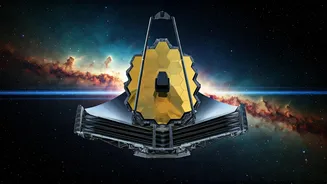
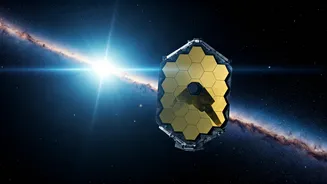
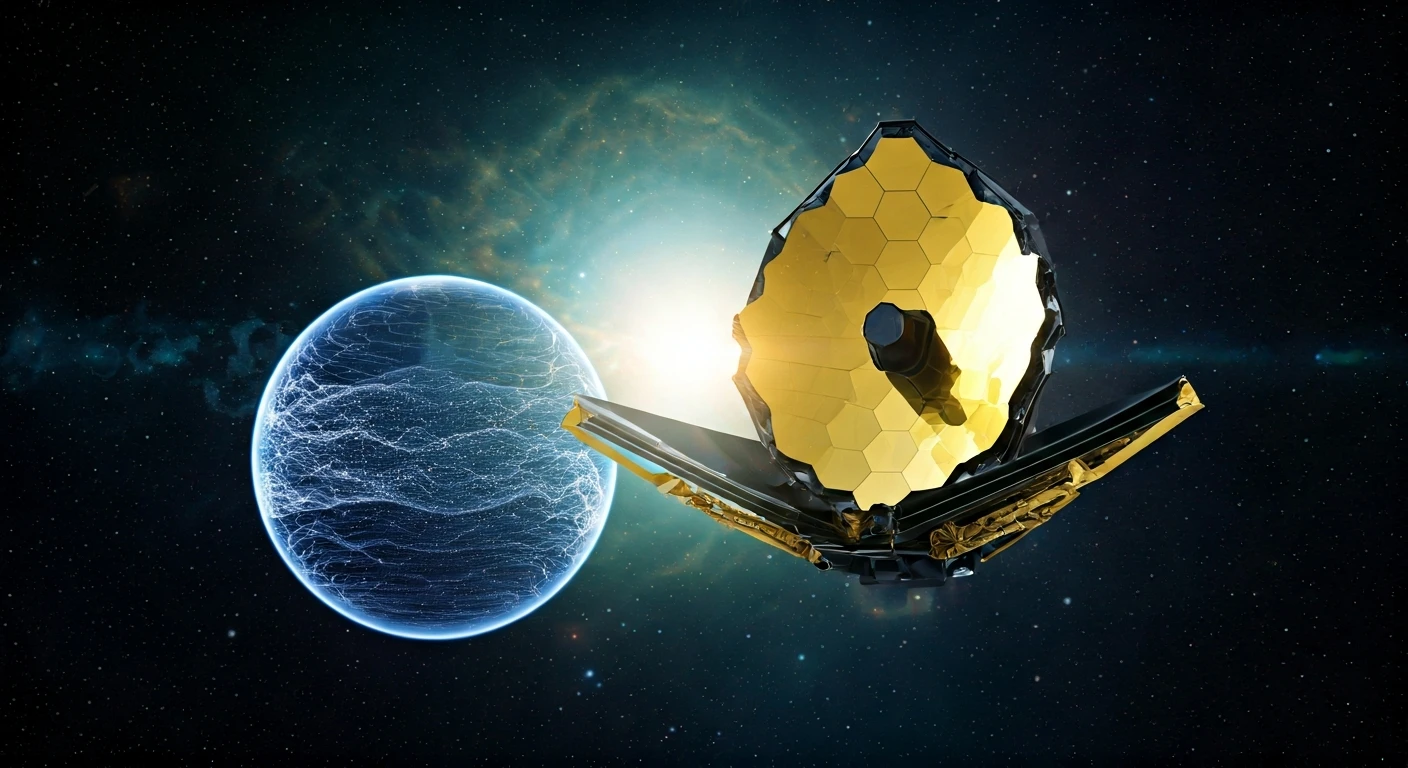
The search for life beyond Earth has entered a revolutionary new phase. Instead of just counting planets, astronomers can now study their atmospheres. Using powerful tools like the James Webb Space Telescope (JWST), scientists are analysing the chemical
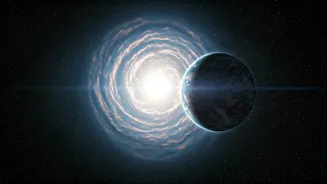
makeup of worlds orbiting distant stars. This is done through a technique called transmission spectroscopy. When an exoplanet passes in front of its star, some of the starlight is filtered through the planet’s atmosphere. By studying which colours of light are absorbed, scientists can identify the gases present, essentially 'sniffing' the air of a world light-years away. This method has opened the door to characterising planets that are fundamentally different from anything in our solar system, including a new, exciting class of planets that could be covered in water.
Welcome to the 'Hycean' Worlds
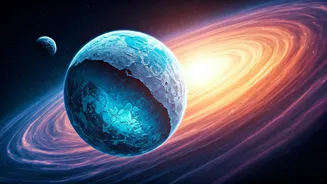
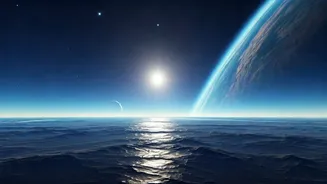
Among the most exciting prospects are 'Hycean' worlds, a term coined from 'hydrogen' and 'ocean'. First theorised in 2021, these are planets larger than Earth but smaller than Neptune, with the potential for deep, global oceans of liquid water under a hydrogen-rich atmosphere. Unlike rocky, Earth-like planets, Hycean worlds can be up to 2.6 times the size of Earth. Their vast, puffy atmospheres make their chemical signatures much easier for telescopes like the JWST to detect. Scientists believe these planets could be quite common in our galaxy, offering a promising new avenue in the search for habitable environments. They represent a 'sweet spot' for observation: potentially habitable, and with atmospheres that are relatively easy to read from trillions of kilometres away.
A Case Study: The Mysteries of K2-18 b
Much of the excitement centres on a specific exoplanet called K2-18 b, located about 124 light-years away. It is 8.6 times as massive as Earth and orbits its star within the 'habitable zone' where conditions could allow for liquid water. JWST observations of K2-18 b have been groundbreaking. Scans revealed an abundance of methane and carbon dioxide, but a telling shortage of ammonia. This specific chemical mix supports the theory that K2-18 b isn't a scorching gas giant, but may indeed have a massive water ocean beneath its hydrogen-rich atmosphere. These findings made K2-18 b the first and most compelling candidate for a Hycean world.
The Hunt for a Telltale Gas
The most tantalising, and controversial, finding in K2-18 b's atmosphere was the potential detection of dimethyl sulfide, or DMS. On Earth, DMS is a gas produced almost exclusively by life, primarily marine phytoplankton. Its potential presence on a distant world immediately sparked intense debate. Some researchers, led by a team at the University of Cambridge, believe a Hycean world teeming with oceanic life is the scenario that best fits the data. However, the scientific community remains cautious. Other studies suggest the DMS signal is not conclusive, and that non-biological chemical processes could potentially produce the gas in such a different atmospheric environment. The claim is still being heavily scrutinized, with some independent analyses finding no conclusive evidence of DMS.
Not All Water Worlds Are Equal
The very idea of an 'ocean world' is complex. Even if planets like K2-18 b or TOI-1452 b—another candidate whose low density suggests it could be up to 30% water by mass—are covered in water, they would be profoundly alien. On some, the ocean could be over 100 degrees Celsius, kept liquid only by immense atmospheric pressure. On others, the pressure at the bottom of such a deep ocean could form a layer of exotic high-pressure ice, separating the water from the rocky core below. This could prevent the kind of rock-water chemical interactions that are thought to be crucial for life's origins on Earth. The science is evolving, with some recent simulations even suggesting that these types of planets may be drier than initially hoped, challenging the entire Hycean hypothesis.