





The Challenge of Disposable Rockets
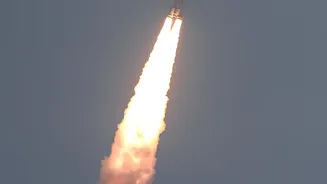
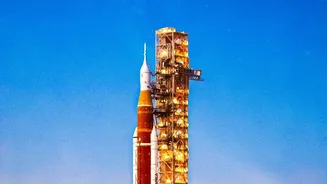
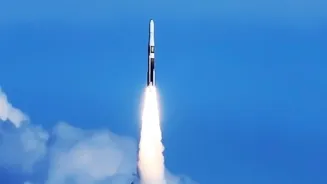
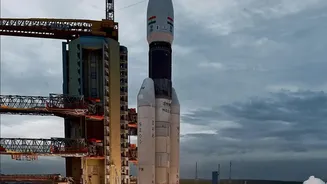
Traditionally, sending anything to space has been an incredibly expensive, one-shot affair. Rockets are marvels of engineering, but they are also disposable. After powering a satellite into orbit, the multi-crore vehicle, or at least its most expensive stages,
would either burn up in the atmosphere or fall into the ocean. It's like building a brand-new car for a single trip and then driving it off a cliff. The fuel is a relatively small part of the overall mission cost; it's the high-tech hardware, especially the complex engines and guidance systems, that accounts for the bulk of the expense. This model has made access to space a high-stakes, high-cost endeavour, limiting the frequency of launches and the scope of space exploration.
Enter 'Pushpak': The Reusable Dream
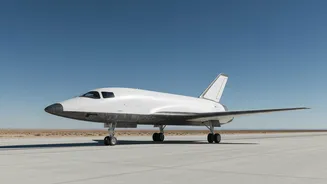
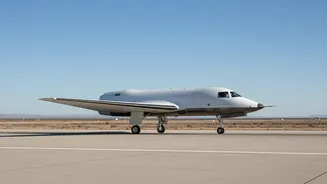
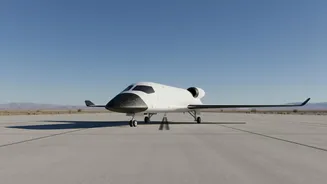
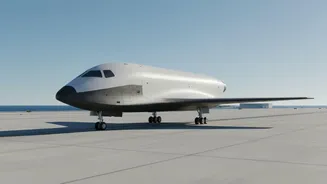
The Indian Space Research Organisation (ISRO) is tackling this problem head-on with its Reusable Launch Vehicle (RLV) program. The star of this program is a winged technology demonstrator named 'Pushpak'. In a series of successful Landing Experiments (LEX), ISRO has proven its ability to land this vehicle autonomously. In these tests, a Chinook helicopter lifts Pushpak to an altitude of 4.5 kilometres and releases it. From there, the vehicle's onboard computers take over completely. It navigates, corrects its course, approaches a runway, and executes a perfect, high-speed landing, just like an aircraft. The latest tests have been increasingly complex, with the vehicle being released under more challenging wind conditions and further away from the runway, forcing it to perform intricate manoeuvres before landing.
How Reusability Slashes Costs
The principle behind reusability is simple: if you can recover and reuse the most expensive parts of the rocket, the cost per launch plummets. ISRO aims to reduce the cost of launching payloads to low Earth orbit by as much as 80 percent. Instead of building a new first stage—the largest and most powerful part of the rocket—for every mission, it can be flown back to Earth, refurbished, and prepared for the next launch. The Pushpak landing tests are a crucial step in mastering the terminal phase of this process. By using wings and landing horizontally, ISRO is pursuing a different technical path than players like SpaceX, who use rocket power for vertical landings. The goal is the same: turn rockets from disposable hardware into a reliable, reusable transport system, fundamentally changing the economics of space.
A Stepping Stone to Bigger Goals
The autonomous landing technology is just one piece of a much larger puzzle. The ultimate vision for ISRO is to develop a Two-Stage-To-Orbit (TSTO) vehicle. In this system, a reusable winged booster (like a scaled-up Pushpak) would carry an upper stage with the satellite to a certain altitude before separating and flying back to land on a runway. The upper stage would then continue to place the satellite in orbit. Mastering the autonomous landing is a critical validation that this vision is achievable. These advancements are not happening in isolation; they are foundational for India's future space ambitions, including supporting the planned Bharatiya Antariksh Station and enabling more frequent, affordable commercial and scientific missions.
The Road Ahead for ISRO
Having successfully completed the landing experiments, ISRO's next major step is the Orbital Re-entry Experiment (ORE). This will involve launching the vehicle into orbit and having it autonomously re-enter the atmosphere to perform a runway landing. This is a far more complex challenge, involving withstanding the extreme heat of re-entry and managing a much higher velocity descent. While a fully operational reusable launch vehicle is still some years away, the successful 'Pushpak' tests have demonstrated that ISRO has mastered some of the most critical technologies required. Each successful test brings India closer to a future where access to space is not just a remarkable achievement, but a routine and affordable reality, strengthening its position in the global space economy.