


A Cosmic Dance at the Dawn of Time
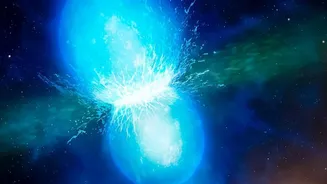
Astronomers have discovered a pair of quasars, designated J1602+4228AB, that are seen as they were just 900 million years after the Big Bang. This isn't just any pair; it's the most compact quasar duo ever found from this early epoch, known as 'cosmic
dawn'. The two objects are separated by a mere 18,100 light-years, which is about a fifth of the diameter of our own Milky Way galaxy. Given their immense distance, spotting them as two distinct objects is a monumental achievement, made possible by the combined power of the JWST and the Gemini North telescope in Hawai'i. The pair has been given the Hawaiian nickname Nāpōwawāʻenakaulua, which evokes the image of two powerful, dark celestial bodies surrounded by brilliant energy.
What is a Quasar, Anyway?
Think of a quasar as a cosmic lighthouse blazing across the universe. At the heart of a quasar is a supermassive black hole, but it's not the black hole itself that shines. Instead, as the black hole's immense gravity pulls in surrounding gas and dust, this material forms a swirling, superheated structure called an accretion disk. The friction and intense forces within this disk heat the matter to extreme temperatures, causing it to release an incredible amount of energy. This glow can be so powerful that a single quasar can outshine all the stars in its host galaxy combined. Finding one quasar is a significant event for astronomers studying how galaxies evolve; finding two so close together suggests their host galaxies are in the process of a dramatic merger.
Rewriting the Book on Black Hole Growth
The existence of J1602+4228AB presents a major puzzle for cosmologists. The two black holes powering the quasars are colossal, with masses of 1.5 billion and 400 million times that of our sun, respectively. According to current models of the universe, there simply shouldn't have been enough time for black holes to grow this massive so soon after the Big Bang. These models suggest it should take at least a billion years for black holes to reach such sizes through feeding and merging. Finding a single such object from this era is puzzling enough, but finding a pair locked in a gravitational dance is truly astonishing. As lead researcher Silvia Onorato of NSF's NOIRLab put it, 'There is no definitive theoretical explanation for how a single one of these giant quasars exists so early in the age of our universe, much less two'.
A Technological Triumph for JWST
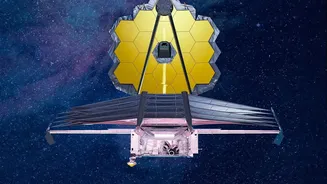
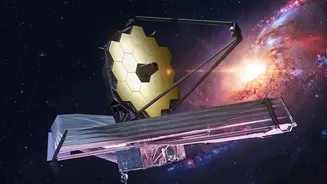
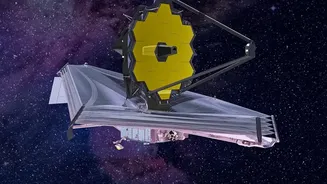
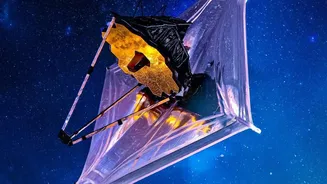
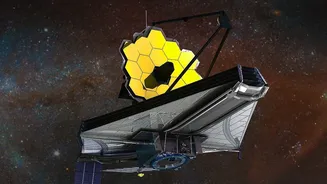
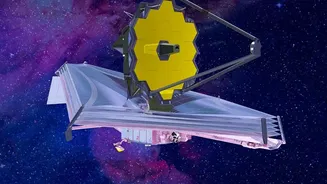
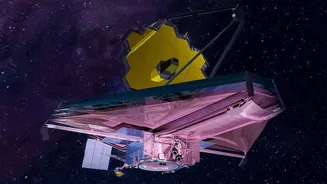
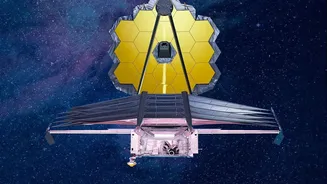
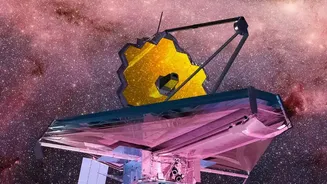
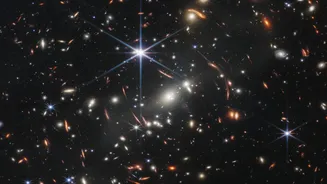
This discovery was a direct result of the JWST's advanced capabilities. The quasar pair was first identified in data from the Aether survey, a JWST program designed to create a census of objects in the early universe. While browsing the data, astronomers noticed that the known quasar J1602+4228A had a faint companion nearby. Distinguishing the two faint, close objects required the incredible sensitivity and resolution of JWST's Near-Infrared Spectrograph (NIRSpec). Follow-up observations with the Gemini North telescope on Maunakea were then used to confirm that they were indeed two separate objects and not a single object gravitationally lensed into a double image. The success of these observations highlights how these powerful new tools are enabling astronomers to find things that were previously impossible to see.
A Signpost to Cosmic Nurseries
So what does this 'impossible' pair tell us? The leading theory is that this system is a signpost for an exceptionally dense region of matter in the early universe. Such an environment would be a cosmic 'hotspot' where galaxy interactions were frequent, fueling both rapid star formation and the accelerated growth of central black holes. This discovery provides a unique natural laboratory for studying how the very first massive galaxies assembled themselves through mergers during these chaotic early times. Rather than an anomaly, Nāpōwawāʻenakaulua might be the first clear look at a process that was common in the young universe but incredibly rare to witness.