



The Unavoidable Cosmic Delay
At the heart of all Mars communication is a delay that no technology can erase. Because of the constant dance of planetary orbits, Earth and Mars are separated by a gulf that takes light itself anywhere from four to 24 minutes to cross. This means a round-trip
conversation—asking a question and receiving an answer—can take up to 48 minutes. On top of that, for about two weeks every 26 months, the Sun moves directly between Earth and Mars in an event called a solar conjunction. During this period, the Sun's immense energy can block or corrupt radio signals, creating a near-total communications blackout. For any mission, robotic or human, these are the fundamental rules of the game.
Robotic Chatter: Slow, Steady, and Patient
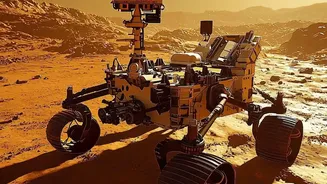
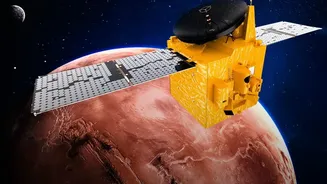
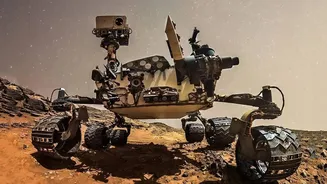
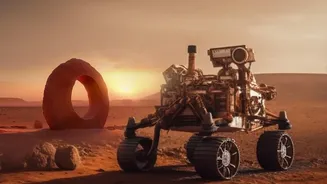
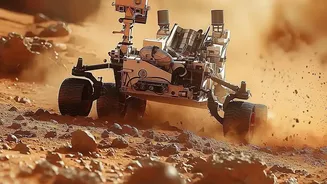
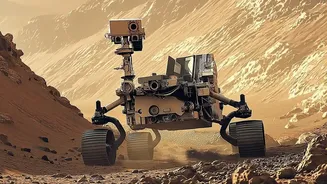
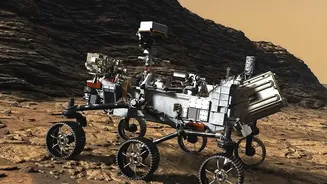
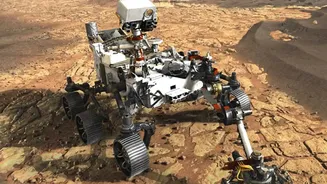
Our current robotic explorers on Mars, like the Perseverance and Curiosity rovers, have been designed around these limitations. They operate on a 'store-and-forward' basis. Instead of being live-controlled like a remote-control car, they receive a set of commands from Earth, execute them autonomously, and then transmit their findings back. This data transfer is often a two-step process. To save power, a rover sends its data over a short distance to an orbiter like the Mars Reconnaissance Orbiter (MRO), which then uses its more powerful antenna to relay the information back to Earth's Deep Space Network (DSN)—a global array of massive radio antennas. Data rates are modest; Perseverance can send data to an orbiter at up to 2 megabits per second (Mbps), but a direct-to-Earth link might only achieve a few thousand bits per second. This is more than enough for sending back stunning images and scientific readings, as robots don't get lonely and can be programmed to simply wait for instructions if a problem arises.
The Human Element: A High-Bandwidth Challenge
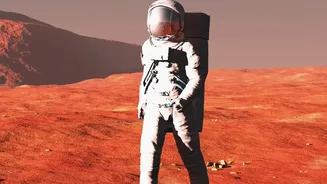
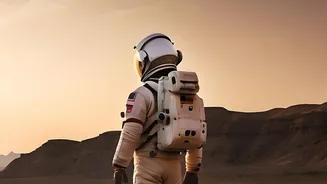
Sending humans to Mars changes the communication equation entirely. Astronauts cannot be put into 'safe mode' during a solar conjunction blackout. They need a constant, reliable link for mission support, but also for something just as critical: their psychological well-being. The inability to have a real-time conversation with mission control or family back home presents a profound challenge to mental health during a mission that could last up to three years. Beyond voice calls, a human crew requires a massive increase in data bandwidth. Think of the data streams needed for high-definition video, complex medical telemetry for health monitoring, and the exchange of large scientific files. While a rover might operate on kilobytes or a few megabits per second, a human outpost would likely require hundreds of megabits, if not gigabits, per second—a quantity the current system is not built to handle.
Bridging the Digital Gulf
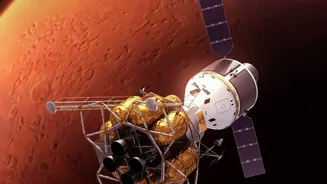
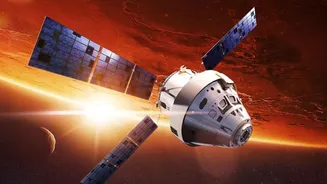
To meet the demands of human exploration, NASA and its commercial partners are developing a new generation of communication technologies. The most promising is laser, or optical, communication. Instead of radio waves, these systems encode data into laser beams, which can carry significantly more information—potentially 10 to 100 times more than current radio systems. Recent demonstrations, like the Deep Space Optical Communications (DSOC) experiment on the Psyche spacecraft, have successfully proven the technology can work across millions of kilometres. However, lasers have their own challenges; the narrow beams require incredibly precise pointing, and they can be disrupted by dust storms on Mars. The ultimate solution will likely be a hybrid system. This future architecture envisions a dedicated network of relay satellites in orbit around Mars, some in areostationary positions (the Martian equivalent of geostationary). These satellites would use a mix of radio and laser links to ensure continuous coverage for astronauts on the surface, creating a true interplanetary internet and ending the reliance on a single-point connection to Earth.