






A Moment Frozen in Time
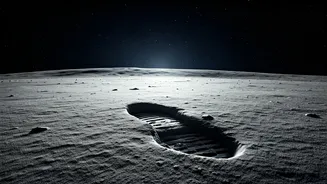
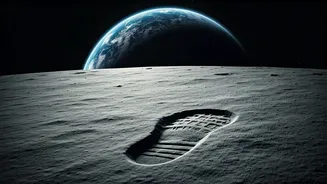
On July 20, 1969, humanity took its first steps on another world. When Neil Armstrong and Buzz Aldrin walked on the lunar surface, they left behind more than just a flag and scientific instruments. They left their footprints. Aldrin’s famous photograph
of his boot print in the fine lunar soil, or 'regolith,' symbolised our arrival. Unlike a footprint left on a sandy beach or a muddy path here on Earth, which might vanish in minutes or hours, the Apollo astronauts' prints are effectively frozen in time. They look today almost exactly as they did over half a century ago, silent testaments to a monumental achievement. To understand this incredible preservation, we first have to appreciate how different the Moon is from our own dynamic, ever-changing planet.
Earth's Unforgiving Cycle
Think about what happens to tracks on Earth. A gust of wind blows sand over them. A rainstorm washes away mud prints. Rivers carve new paths, glaciers grind down mountains, and plants and animals constantly disturb the soil. Our planet is a hotbed of geological and biological activity, driven primarily by its atmosphere and water. This process of erosion is relentless. It’s why ancient ruins crumble and coastlines shift. Earth is constantly recycling its surface, wiping the slate clean over and over again. The Moon, however, operates by a completely different set of rules. It has none of the forces that work so tirelessly to erase history on our home world.
The Great Stillness of the Moon
The primary reason the footprints remain is simple: the Moon has virtually no atmosphere. An atmosphere is a blanket of gas that creates weather. It’s the source of wind that blows dust around and the water vapour that forms clouds and rain. Without an atmosphere, there is no wind on the Moon. There is no rain. There is no weather of any kind. The fine, powdery regolith that the astronauts stepped in was kicked up and settled exactly where it landed, with no breeze to disturb it a second later. The silence is absolute, and the stillness is almost perfect. This lack of an atmosphere means the primary agents of erosion we experience on Earth are completely absent, allowing delicate features like a boot print to persist indefinitely.
The Slowest Erosion Imaginable
This doesn't mean the Moon is entirely static. There is a form of erosion, but it operates on a timescale that is almost incomprehensible. The lunar surface is constantly being bombarded by micrometeorites—tiny particles of space dust, often no bigger than a grain of sand, travelling at tremendous speeds. This perpetual cosmic rain slowly 'gardens' the surface, churning the top layer of regolith. Additionally, the solar wind, a stream of charged particles from the Sun, bombards the surface, slowly breaking down rocks. However, these processes are incredibly slow. Scientists estimate that it takes millions of years for these forces to erode just a few millimetres of lunar rock. Therefore, a footprint several centimetres deep is expected to remain recognisable for millions of years, long after every trace of our current civilisation on Earth has vanished.
A Museum of Human Exploration
The footprints are just the beginning. Every Apollo mission left behind a treasure trove of artefacts. There are discarded lunar modules, rovers, scientific experiments, tools, cameras, and even golf balls. The tracks of the Lunar Roving Vehicle are etched into the dust just as sharply as the boot prints. The entire Moon has become a pristine, untouched museum of humanity's first forays into the cosmos. Space agencies like NASA can even see these sites with modern lunar orbiters, confirming that everything is right where we left it. These sites are so historically and scientifically valuable that there are ongoing discussions about how to protect them from potential future lunar missions, ensuring they remain undisturbed for future generations to study and marvel at.