






Start with a Ruthless Declutter
Before you can organize, you must declutter. The first step is to clear your countertops of everything that doesn't serve a daily purpose. Be honest: does that air fryer you use twice a year need prime real estate? Go through your cabinets and drawers,
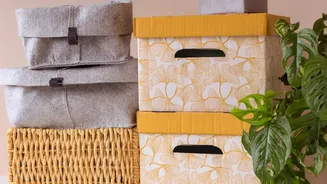
removing items you no longer use. Experts suggest the four-box method: create piles for 'keep,' 'donate,' 'trash,' and 'relocate.' Items that don't belong in the kitchen—like mail, keys, or toys—should be moved to their proper homes immediately. Clearing surfaces has the single biggest impact on making your kitchen feel larger and more manageable.
Think Vertically: Use Your Walls
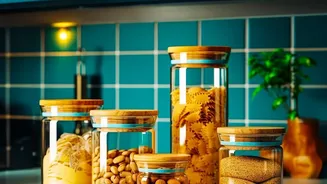
In most Indian kitchens, wall space is the most underutilised asset. When counter space is limited, the only way to go is up. Installing simple floating shelves can instantly create storage for everyday items like spice jars, tea, and sugar containers, freeing up your cabinets for heavier things. Consider adding a magnetic knife strip to keep knives safely off the counter or installing hooks and rods to hang frequently used tools like ladles (karchi), tongs (chimta), and spatulas. Even a simple pegboard can be a flexible, modern solution for hanging everything from pans to small baskets.
Create 'Mission-Specific' Zones
Professional chefs organize their kitchens into stations for maximum efficiency, and you can do the same. Designate zones for different tasks to reduce unnecessary movement. For example, create a 'cooking zone' near the stove with your oils, spices, and most-used pans. A 'preparation zone' should be near your largest counter space with cutting boards, knives, and mixing bowls. Finally, a 'cleaning zone' should be centered around the sink. By grouping related items, you spend less time searching and more time cooking, which is crucial when you're preparing multiple festive dishes at once.
Optimise Your Cabinet and Drawer Space
Simply having cabinets isn't enough; you need to make them work harder. Most cabinet shelves have significant wasted vertical space. Simple wire shelf risers can effectively double your storage, allowing you to stack plates below and bowls above. For heavy items common in Indian cooking, like tawas and large kadhais, use vertical dividers to store them on their side, like files in a cabinet. This prevents messy stacking and makes it easier to grab the one you need without unstacking everything. For deep corner cabinets, a lazy Susan or rotating shelf can bring hard-to-reach items to the front with a simple spin.
Re-evaluate Your Large Appliances and Gadgets
Festival cooking often requires special appliances, but day-to-day, they can be major space hogs. Identify which gadgets are essential for your festival menu and which are just 'nice-to-haves.' The items you only use seasonally can be stored away in a less accessible spot, like a high cabinet or a storage room, until needed. For smaller appliances that you do use regularly, consider creating an 'appliance garage'—a dedicated cabinet that can hide your toaster, mixer, or kettle, keeping your main prep areas clear and visually uncluttered. This reduces the visual noise that makes a kitchen feel chaotic.
Bring in Mobile Solutions
If you are truly short on space, a rolling kitchen cart or trolley can be a game-changer. It can serve as an additional surface for chopping vegetables, a temporary bar for serving drinks, or extra storage for ingredients you need close at hand. The best part is its flexibility; you can move it exactly where you need it during a busy cooking session and then tuck it away into a corner when you're done. Some carts even come with built-in hooks, shelves, and drawers, providing a multi-functional workstation on wheels.