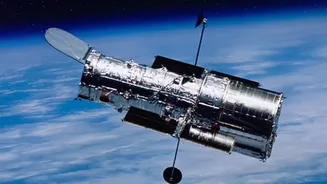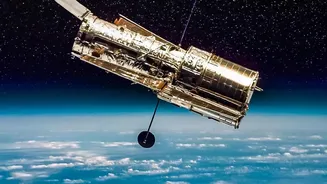






For over 35 years, the Hubble Space Telescope has been humanity's eye on the universe. But that eye is slowly closing as its orbit decays. Now, NASA is turning to the commercial space industry for a bold rescue plan.
An Icon's Inevitable Descent
Since its launch in 1990, the Hubble
Space Telescope has delivered breathtaking images and groundbreaking science, fundamentally changing our understanding of the cosmos. But Hubble has no engine of its own to maintain its altitude. It operates in low Earth orbit, where the faint wisps of Earth's atmosphere create a constant drag, slowly pulling it downward. Its orbit has already decayed from its original 612 kilometers to well under 500 kilometers. Without a boost, NASA projects it will make an uncontrolled reentry into the atmosphere sometime in the early to mid-2030s.
A Call for Commercial Heroes
Recognizing the threat, NASA has formally issued a Request for Information (RFI), asking private companies for their ideas on how to address Hubble's situation. This isn't a contract, but rather a market survey to see what's possible in the rapidly evolving commercial space sector. The request, which has a response deadline of November 30, outlines three potential missions for a commercial partner: capture Hubble and boost it to a higher, more stable orbit; service it with new components to enhance its performance; or guide it to a safe, controlled deorbit to prevent it from falling uncontrollably. The company would be responsible for the entire mission, including the spacecraft, launch, and operations.
Familiar Concepts, New Urgency
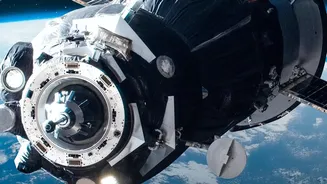
This isn't the first time a private rescue has been considered. In 2022, NASA and SpaceX conducted a study to assess the feasibility of using a Dragon spacecraft for a reboost mission, partly in partnership with the Polaris Program led by billionaire Jared Isaacman. After reviewing eight responses from the industry to a similar call for ideas, NASA decided not to proceed at that time, citing risks. However, with Isaacman now serving as NASA's Administrator, the agency is revisiting the concept with renewed urgency, opening the door for any company to propose a solution. 'We owe it to the American taxpayer and the scientific community to explore them', Isaacman stated, highlighting the need to find innovative and cost-effective ways to extend the life of the valuable observatory.
Who Might Answer the Call?
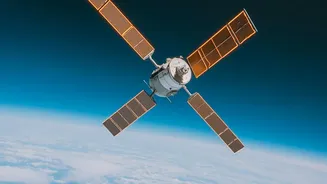
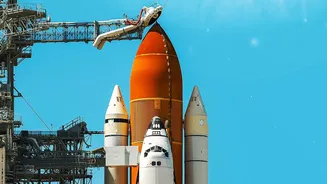
While SpaceX remains a prominent candidate due to its previous study and the capabilities of its Dragon capsule, the field is open. The new RFI invites proposals for both robotic and crewed missions. A robotic 'tug' could autonomously rendezvous with and push Hubble into a higher orbit. This approach is favored by companies specializing in in-space servicing, like Astroscale and Momentus, who submitted a joint concept during the last review cycle. Alternatively, a crewed mission, while more complex, could potentially perform more intricate servicing tasks, echoing the successful Space Shuttle missions that kept Hubble operating for decades. The final choice will depend on a balance of cost, risk, and technical readiness.
A Testbed For a New Space Economy
Saving Hubble is about more than just preserving a single, iconic telescope. A successful commercial mission would serve as a powerful proofofconcept for an entirely new sector of the space economy : inorbit servicing. The ability to affordably and reliably visit, refuel, repair, and relocate satellites could revolutionize space operations for both government and commercial clients. It could extend the lives of billions of dollars worth of assets, help manage the growing problem of space debris, and create a new market for innovative spacetech companies. NASA's call to save Hubble is effectively an invitation for industry to demonstrate that the era of disposable , singleuse satellites is coming to an end , replaced by a more sustainable and dynamic model of spaceflight.