





The Indivisible Rule of Black Holes
For decades, our understanding of black holes has been guided by a simple rule: they merge, but they never split. This isn't just an assumption; it's rooted in fundamental physics, particularly the laws of thermodynamics. A key concept is entropy, which
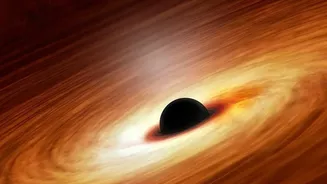
is often described as a measure of disorder. According to Stephen Hawking's area theorem, the surface area of a black hole's event horizon—its boundary of no return—can never decrease. Since splitting one large black hole into two smaller ones would result in a lower total surface area, and therefore lower entropy, the process is considered thermodynamically forbidden. This principle has been a cornerstone of black hole physics, reinforcing their image as the universe's ultimate collectors, always taking in matter and energy but never giving anything back in one piece.
Finding a Loophole in the Law
A new study published in the journal 'Physical Review D' challenges this long-held belief, at least in theory. Researchers from the University of Southern Denmark and their collaborators didn't find evidence of black holes splitting in our universe, but they explored the extreme conditions under which it might be possible. They discovered a potential loophole that hinges on one crucial factor: rotation. While a stationary black hole is bound by the law of non-decreasing entropy, a spinning one is a different beast entirely. A rotating black hole has less entropy than a non-rotating one of the same mass, which opens up a narrow window of possibility. The researchers calculated that if a black hole were spinning at an incredibly high speed, it might be able to overcome the thermodynamic barrier that normally prevents it from dividing.
The 'Pair-of-Pants' Split
The scientists describe this theoretical split using a curious analogy: a 'pair-of-pants topology'. Imagine the event horizon of the original black hole as the single opening at the top of a pair of trousers. As it divides, it would trace a shape through spacetime that branches into two separate 'legs', each representing a new, smaller black hole. However, for this to work, two incredibly specific and extreme conditions must be met. First, the black hole must be rotating at or very near its maximum possible speed. Any slower, and the split remains thermodynamically unfavorable. Second, the two newly formed black holes must have enough energy to escape each other's immense gravitational pull. If they don't separate quickly enough, they would simply fall back together and merge again. This requirement makes the window for a successful split extremely narrow.
Theoretical, For Now
It is crucial to understand that these findings are purely theoretical. Astronomers have never observed a black hole splitting, and the conditions required are so extreme they may not exist in our universe. The study is more of a thought experiment, pushing the boundaries of Einstein's theory of general relativity to see where it might bend or break. Some theories that try to unify gravity with quantum mechanics involve extra dimensions, and in these hypothetical scenarios, black hole behaviour can get even stranger. For instance, simulations in a five_dimensional universe have shown that ring_shaped black holes could become unstable and break apart into multiple smaller ones. While our universe appears to have only four dimensions (three of space and one of time), these higher_dimensional theories help physicists explore the absolute limits of gravitational laws.
Why It Matters for Physics
Even if black holes in our cosmos never actually divide, this research is far from a mere mathematical curiosity. By exploring such exotic scenarios, physicists can test the robustness of our most fundamental theories about the universe. It forces them to confront the intersection of general relativity and quantum mechanics, two pillars of modern physics that have yet to be fully reconciled into a single 'theory of everything'. According to the researchers, it may be possible to indirectly detect signs of such splits. Small, primordial black holes, hypothetically formed at the dawn of the universe, might be more prone to this kind of division. If they do split, they could release bursts of high_energy light, like gamma_rays, that telescopes could potentially detect, offering a new and unexpected window into the most extreme physics in the cosmos.