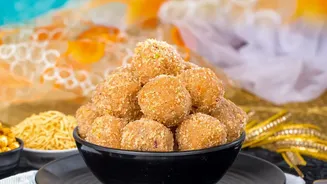




Besan Laddoo: The Universal Favourite
No Diwali is truly complete without the humble Besan Laddoo. This golden sphere of goodness, made by slowly roasting gram flour (besan) in ghee until it emits a nutty aroma, is a staple in households across North, Central, and Western India. The roasted
flour is then mixed with powdered sugar and a hint of cardamom, creating a melt-in-your-mouth texture that feels like a warm hug. More than just a sweet, the Besan Laddoo is a symbol of auspiciousness and prosperity, often offered to Goddess Lakshmi and Lord Ganesha during Diwali puja. Its simplicity is its strength, evoking feelings of nostalgia and the comforting chaos of festive kitchens. While countless sweet trends come and go, this laddoo remains an evergreen reminder of shared joy and tradition.
Anarsa: The Crispy Treat of Maharashtra and Bihar
Anarsa is a testament to the fact that good things take time. This unique pastry-like sweet, popular in Maharashtra and Bihar, requires patience but rewards with an unforgettable texture. It is made from a dough of rice flour and jaggery or sugar, which is often left to ferment for a few days. These small discs are then coated in poppy seeds (khus-khus) and deep-fried in ghee. The result is a delightful contrast: a crisp, slightly crunchy exterior that gives way to a soft, chewy interior. Anarsa, which has variations across India under names like Adhirasam in Tamil Nadu and Ariselu in Andhra Pradesh, is a cherished part of Diwali 'faral' (a platter of festive snacks). Its long shelf life made it a practical and precious sweet in older times, and its unique flavour continues to make it a festive favourite.
Gujiya: The Crescent-Shaped Delight
Known as Gujiya in the North and Karanji in Maharashtra, this crescent-shaped, deep-fried pastry is an icon of festive indulgence, especially during Diwali and Holi. The outer shell is made from a simple dough of flour and ghee, which becomes flaky and crisp upon frying. But the magic lies inside. The filling is a rich, sweet mixture that varies by region. The North Indian Gujiya is typically stuffed with sweetened khoya (milk solids), dried fruits, and nuts. In Maharashtra and Gujarat, the Karanji or Ghughra often features a filling of roasted semolina, coconut, poppy seeds, and nuts. Each bite offers a symphony of textures—the crunchy pastry giving way to a soft, fragrant, and sweet filling. Shaping these pastries is often a communal activity, making them a true labour of love.
Mysore Pak: A Royal Confection from Karnataka
Born in the royal kitchens of the Mysore Palace, this sweet is as rich in history as it is in flavour. Legend has it that a palace chef named Kakasura Madappa created it in the early 20th century while experimenting with gram flour, sugar, and copious amounts of ghee. The Maharaja was so enchanted that he named it after the city, and a culinary star was born. Mysore Pak has a dense, fudgy texture that melts in your mouth, leaving behind the nutty taste of roasted besan and the richness of ghee. There are two main versions: a softer, fudge-like one and a harder, more porous one. Both are equally delicious. Traditionally served at weddings and festivals in South India, it has become a Diwali favourite nationwide.
Rasabali: The Pride of Odisha
Originating from the Baladevjew Temple in Kendrapara, Rasabali is a divine sweet from Odisha that will captivate your senses. It consists of small, flattened patties made from chhena (fresh farmer's cheese), which are deep-fried until they turn a beautiful reddish-brown. These golden discs are then soaked in a bath of thickened, sweetened milk, or rabri, which is delicately flavoured with cardamom. The fried chhena patties absorb the creamy milk, becoming incredibly soft and spongy. Though it sounds similar to Rasmalai, the deep-frying step gives Rasabali a uniquely rich flavour and texture. As one of the 56 sacred offerings (Chhappan Bhog) at the Jagannath Temple, it is a sweet steeped in devotion and tradition.
Singori: A Fragrant Gem from Uttarakhand
Venture into the hills of Kumaon and you'll discover Singori, a rustic and aromatic sweet that is a true speciality of Uttarakhand. This delicacy is made from khoya that is cooked with sugar until it forms a soft, dense mass, similar in texture to Kalakand or Peda. What makes Singori truly special is its presentation. The sweet mixture is shaped into a cone while wrapped in a fresh Maalu leaf. This leaf, found in the Himalayan region, infuses the sweet with a subtle, unique fragrance that is earthy and refreshing. Often garnished with grated coconut, this sweet offers a delicate and distinctive flavour that truly captures the essence of the mountains.