

A New Era of Cosmic Chemistry
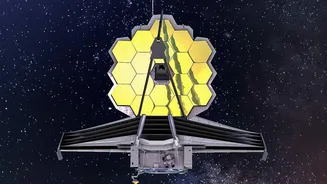
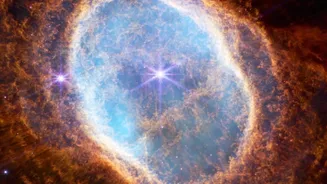
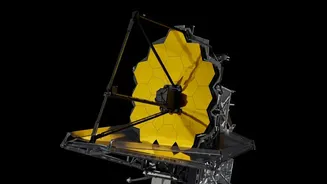
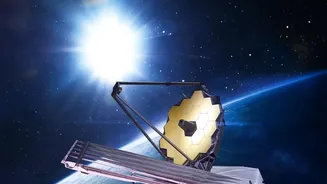
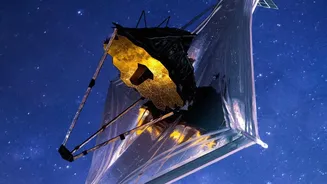
Before the James Webb Space Telescope, detecting the atmosphere of a planet hundreds of light-years away was a monumental task, often yielding fuzzy, ambiguous results. Now, what was once science fiction is becoming routine observation. JWST is ushering
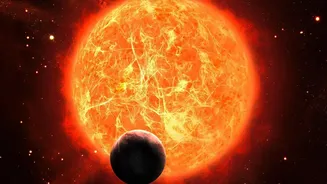
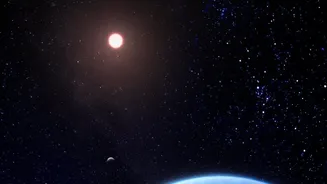
in a new era of exoplanet research by using its powerful infrared instruments to perform a technique called transit spectroscopy. When an exoplanet passes in front of its host star, a tiny fraction of the starlight filters through the planet's atmosphere. By analysing the spectrum of that light, scientists can identify the chemical fingerprints of molecules present, including the one most crucial for life as we know it: water. This technology allows us to read the chemical recipe of an alien sky with stunning precision.
Water, Water Everywhere?
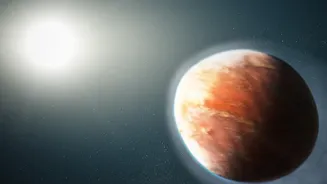
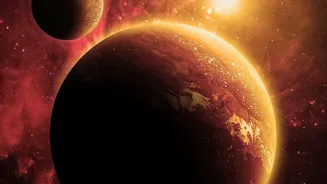
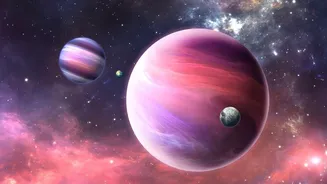
JWST has already delivered a cascade of discoveries, confirming water vapour in the atmospheres of various exoplanets. Landmark observations of gas giants like WASP-96b revealed unambiguous signs of water. But the telescope's capabilities go far beyond simple detection. On another 'hot Saturn' named WASP-39b, located 700 light-years away, JWST didn’t just find water; it provided a complete molecular menu of its atmosphere. This included sodium, potassium, and carbon dioxide, giving scientists a holistic view of the planet’s chemistry. Even more remarkably, it detected sulfur dioxide for the first time on an exoplanet, a molecule created by chemical reactions triggered by the star's light, similar to how Earth's ozone layer is formed. This points to active, dynamic chemistry taking place in these distant skies.
Not Just Any Water
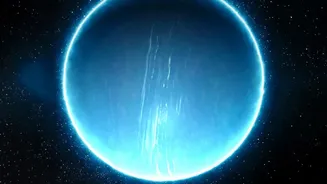
The precision of JWST is so extraordinary that it can differentiate between types of water. On WASP-39b, astronomers detected "semi-heavy water," a variant where one hydrogen atom contains an extra neutron. This might sound like a small detail, but it's a huge clue for understanding how the planet formed and migrated over its lifetime. The ratio of heavy to regular water can tell a story about a planet’s history, including whether it formed far from its star where ice is plentiful. Elsewhere, on a famously strange "Pink Planet" 57 light-years away, Webb confirmed an atmosphere containing water vapour alongside methane, ammonia, and clouds made of salt. Each discovery adds another piece to the complex puzzle of planetary evolution across the galaxy.
Clarifying the Cosmic 'Scan'
While the headline mentions "deep-field scans," it's helpful to clarify how Webb performs this particular magic. Its famous deep-field images, which capture thousands of ancient galaxies in a single shot, use its imaging instruments to stare at one patch of sky for a long time. To study an exoplanet's atmosphere, however, Webb uses its spectrographs—instruments designed to break down light into its constituent wavelengths. It’s the same revolutionary telescope and the same incredible infrared sensitivity, just deployed in a different, highly specialized mode. It’s less like taking a photo and more like analysing a fingerprint left behind in starlight as a planet passes by.
The Search for Habitable Worlds
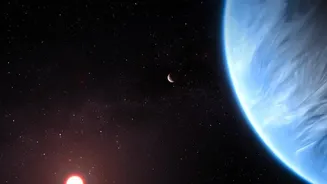
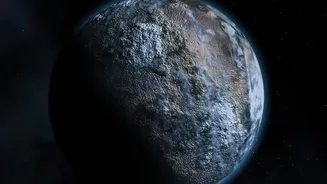
Of course, the ultimate goal is to find rocky, Earth-like planets with atmospheres that could support life. While many of JWST's detailed atmospheric profiles have been of large, gassy planets, these initial findings are crucial for refining the techniques. However, recent studies suggest a new challenge: on a common class of planets called 'sub-Neptunes,' a significant amount of water might be hidden deep within the planet, beyond the reach of atmospheric scans. This means that the water JWST detects in the atmosphere might only be the tip of the iceberg. Finding water vapour is not the same as finding life, but it’s a critical step. By confirming the presence of this vital ingredient across a variety of worlds, JWST is writing the first chapter in the story of comparative planetology and guiding the search for a world that might, one day, feel a little more like home.