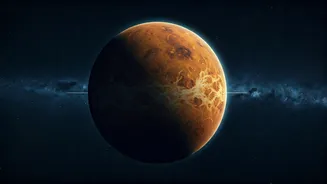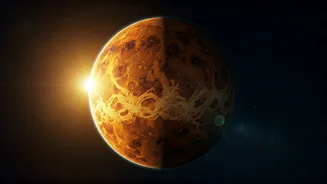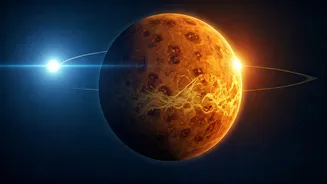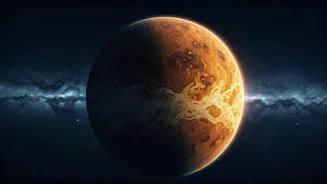





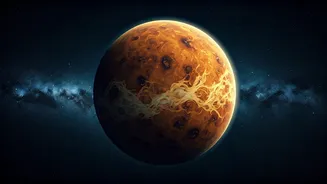


First, Let’s Define a 'Year'
Before we dive into the weirdness of Venus, let's get our terms straight. For any planet, a 'year' is simply the time it takes to complete one full orbit around its star. Here on Earth, that journey takes approximately 365.25 days, which is why we have
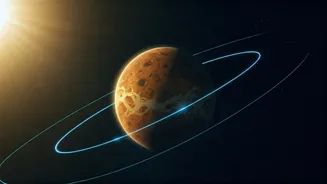
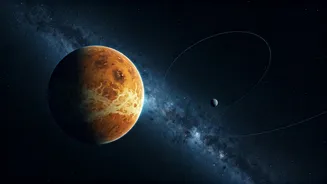
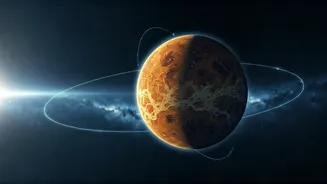
a calendar year of 365 days and add a leap day every four years. It’s a straightforward concept: one lap around the Sun equals one year. Venus, being the second planet from the Sun, has a much smaller orbit than Earth. It zips around the Sun relatively quickly, completing its full journey in just about 225 Earth days. So, one Venusian year is roughly two-thirds of an Earth year. So far, so normal.
Now, What Exactly Is a 'Day'?
This is where things get interesting. A 'day' refers to the time it takes for a planet to complete one full rotation on its own axis. This is also known as a 'sidereal day'. On Earth, this takes about 23 hours and 56 minutes. The 24-hour 'solar day' we are used to measures the time from one sunrise to the next, which is slightly longer due to our movement around the Sun. But for the headline’s claim, the key is the sidereal day—the fundamental spin of the planet. And on Venus, this spin is incredibly, almost unbelievably, slow. The planet rotates on its axis at a pace that is slower than any other planet in our solar system.
Putting It All Together on Venus
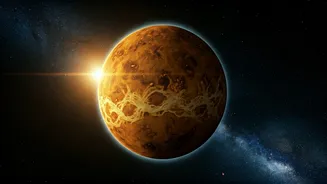
Here's the mind-bending math. We already know a Venusian year (its orbit) is about 225 Earth days long. Now for the shocker: a single Venusian sidereal day (one full rotation) takes approximately 243 Earth days. Let that sink in. The planet takes longer to spin once on its axis than it does to complete its entire journey around the Sun. This is why a day on Venus is longer than its year. It’s a celestial curiosity born from an extremely sluggish rotation paired with a relatively quick orbit. By the time Venus has completed one full spin, it has already finished a full lap around the Sun and is well into its next year.
The Planet That Spins Backwards
As if a day being longer than a year wasn't strange enough, Venus adds another twist: it spins backwards. Most planets in our solar system, including Earth, rotate counter-clockwise on their axis (prograde motion). Venus, however, rotates clockwise (retrograde motion). The only other major planet to do this is Uranus, which is tilted so far on its side it essentially rolls along its orbit. On Venus, this means the Sun rises in the west and sets in the east. Scientists are not entirely sure why Venus spins this way. Leading theories suggest a massive collision with an asteroid or another planet-sized body in its distant past may have reversed its spin, or that the powerful pull of its thick atmosphere over billions of years slowed and eventually reversed its original rotation.
A Sunrise You’d Wait Months For
While the sidereal day is 243 Earth days, the backward spin actually makes the time between sunrises (the solar day) a bit shorter. Because the planet is rotating clockwise while orbiting the Sun counter-clockwise, the Sun appears to move across the sky faster than it otherwise would. The result is a solar day on Venus that lasts about 117 Earth days. This means you would experience roughly 58 days of continuous daylight followed by 58 days of continuous darkness. Combined with its toxic, crushing atmosphere and surface temperatures hot enough to melt lead, this eternal day-night cycle makes Venus one of the most inhospitable and fascinating worlds in our solar system.