



Cosmic Detective Work
Since their discovery in 2022, the nature of these 'little red dots,' or LRDs, has been a major puzzle for astronomers. These objects are extremely distant, meaning we see them as they were in the universe's infancy, just a few hundred million years after
the Big Bang. Their distinct red colour comes partly from their light being stretched over billions of years as the universe expands—a phenomenon called redshift. The question has been: what are they? Early theories pointed to two main culprits: they are either incredibly compact, dust-shrouded galaxies furiously forming new stars, or they are the fiercely bright hearts of active galactic nuclei, powered by supermassive black holes devouring surrounding matter. Distinguishing between these two possibilities is key to understanding how the first galaxies and black holes formed so quickly.
A Breakthrough from a Cosmic Cousin
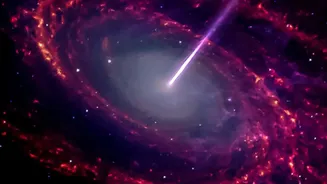
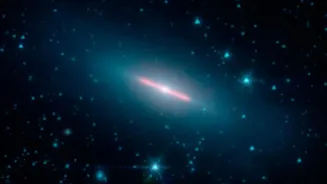
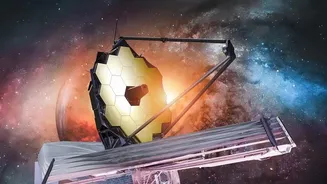
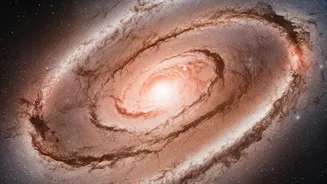
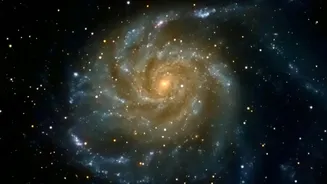
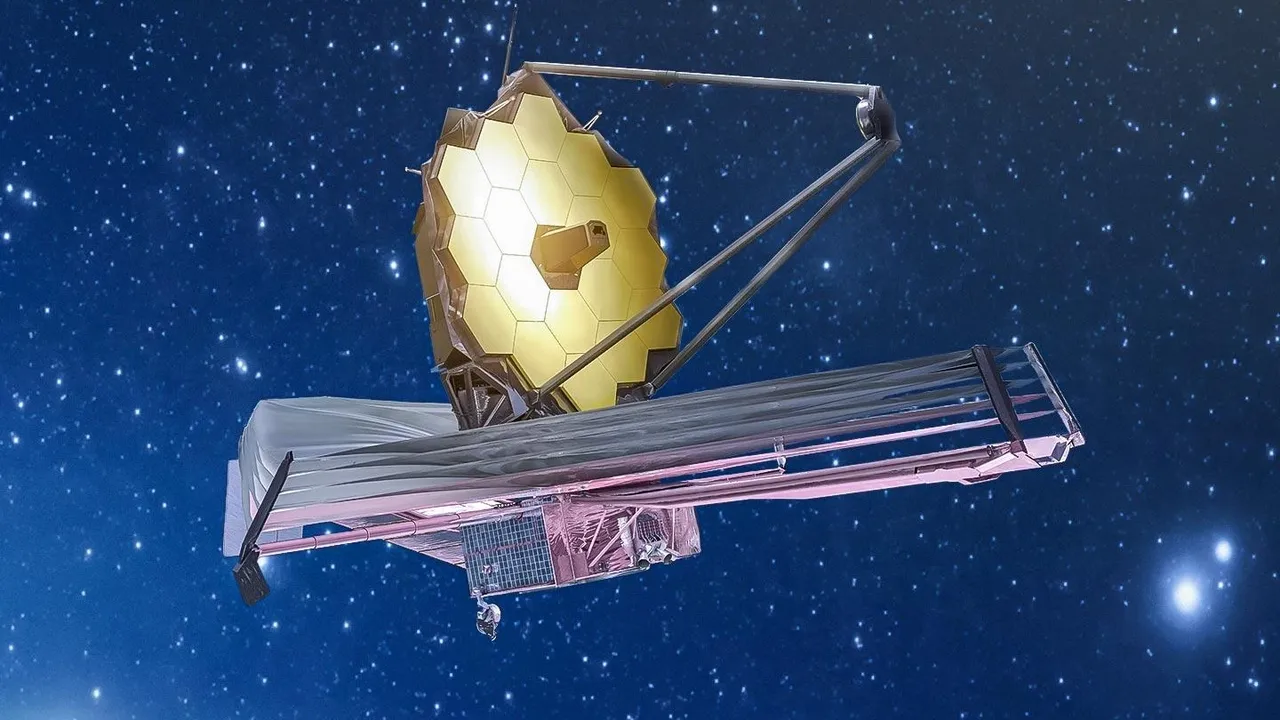
The latest research, published in late July 2026 in The Astrophysical Journal, offers a compelling new piece of evidence. Instead of focusing only on the most distant LRDs, a team of astronomers turned Webb’s gaze to a more recent, and therefore clearer, subject: a spiral galaxy nicknamed the 'Saguaro'. This galaxy, seen as it was about 3.3 billion years after the Big Bang, has a bright, compact, reddish core that shares all the key characteristics of a distant LRD. Critically, however, because the Saguaro is closer, Webb can resolve not just its core but the vast spiral galaxy surrounding it. This provided the researchers with a crucial insight: What if LRDs aren't a unique type of object, but just the visible 'tip of the iceberg'?
The Illusion of Distance
To test this theory, the researchers performed a clever thought experiment. They digitally simulated what the Saguaro galaxy would look like if it were located much further away, at the same distance as the earliest LRDs. As they 'pushed' it back in cosmic time, the faint spiral arms and the rest of the host galaxy faded into the blackness of space, rendered invisible by the immense distance. All that remained was the bright, compact red core—a dead ringer for a classic little red dot. The conclusion is a potential game-changer: many of the LRDs Webb has discovered may not be lonely dots at all. They could be the active, supermassive black hole cores of much larger galaxies whose fainter structures are simply beyond Webb's ability to detect at such extreme distances.
A Temporary, Violent Phase
This discovery helps solve another perplexing mystery: why do LRDs seem to be abundant in the early universe but then vanish from view as time goes on? The Saguaro study suggests they don't vanish but instead evolve. The LRD phase may be a temporary, but violent, period of rapid growth for a supermassive black hole. As the black hole's feeding frenzy slows and the surrounding host galaxy grows larger and more prominent, the object would no longer look like a little red dot. It would simply look like a normal galaxy with a supermassive black hole at its center—the kind we see throughout the universe today. This theory elegantly connects the cosmic dawn to the modern cosmos, suggesting LRDs are not a cosmic dead-end, but a vital evolutionary step.