




India's Next Interplanetary Leap
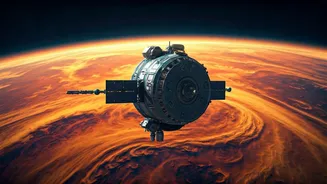
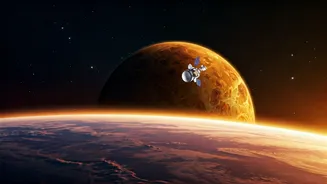
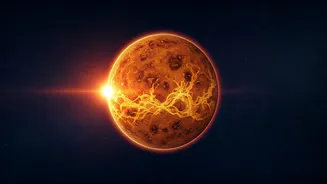
Following the historic successes of the Chandrayaan moon missions and the Mangalyaan Mars orbiter, the Indian Space Research Organisation (ISRO) is setting its sights on our other planetary neighbour: Venus. The mission, officially the Venus Orbiter Mission
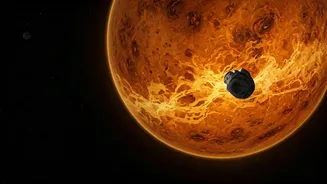
but popularly known as Shukrayaan-1 (from the Sanskrit for 'Venus Craft'), represents India’s next major step in planetary exploration. After receiving formal government approval in late 2024, the mission is now gathering momentum, with a scheduled launch date of March 29, 2028. The spacecraft will be launched aboard India's heaviest rocket, the LVM-3, and is expected to enter orbit around Venus in July 2028 after a journey of 112 days. This ambitious project is not just a technology demonstrator but a dedicated science mission designed to unravel the mysteries of a planet that, despite its similarities to Earth, followed a dramatically different evolutionary path.
Why Venus, Earth’s ‘Evil Twin’?
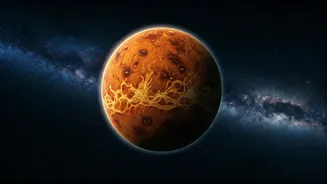
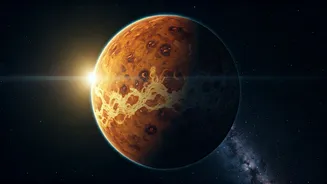
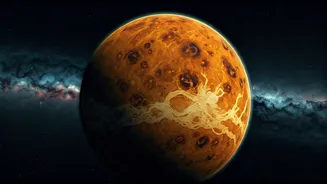
Venus is a world of extremes. Though similar to Earth in size, mass, and density, its surface is a hellscape with temperatures averaging 460°C—hot enough to melt lead—and a crushing atmospheric pressure 90 times greater than Earth's. Its skies are filled with thick clouds of sulfuric acid, completely obscuring the surface below. But scientists believe it wasn't always this way. Evidence suggests Venus may have once hosted liquid water oceans, similar to early Earth. So, what went so catastrophically wrong? The leading theory points to a runaway greenhouse effect. At some point in its history, Venus began trapping too much heat. This turned its oceans into steam, and the water vapour in the atmosphere trapped even more heat until the entire planet became a scorching, inhospitable furnace. Understanding this process is the primary motivation for sending a new generation of orbiters, including Shukrayaan-1.
The Climate Angle Explained
The core of Shukrayaan-1's purpose lies in studying Venus as a natural laboratory for climate change. Venus's atmosphere is composed of about 96% carbon dioxide, an extreme example of the greenhouse effect that warms our own planet. By studying the dynamics of this thick, super-rotating atmosphere, scientists hope to gain invaluable insights into how a greenhouse effect can spiral out of control. While Earth is not at risk of a Venus-style runaway scenario, the data will help refine our climate models. The mission will provide a detailed look at the mechanisms—atmospheric composition, cloud dynamics, and solar wind interaction—that transformed a potentially habitable world into a toxic oven. This makes Shukrayaan-1 more than just planetary science; it’s a mission to understand the outer limits of climate change and the forces that make a planet habitable—or hostile.
A Toolkit for Unlocking Secrets
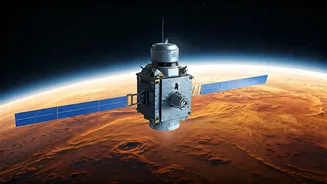
To peer beneath the thick clouds, Shukrayaan-1 will be equipped with a suite of advanced instruments. Its primary payload is a high-resolution Synthetic Aperture Radar (SAR), which can map the planet's surface in remarkable detail, regardless of the cloud cover. This will help scientists understand Venus’s geological history, identifying volcanic hotspots and ancient lava flows. The mission will also carry a ground-penetrating radar, a first for Venus exploration, to study the shallow sub-surface. Other instruments, including some developed through international collaboration with Sweden, Russia, and Germany, will study the atmospheric chemistry, the interaction with solar wind, and the mysterious super-rotation of Venus's clouds. This comprehensive toolkit will provide an unprecedented view of how the planet's surface and atmosphere interact, a key piece of the climate puzzle.