


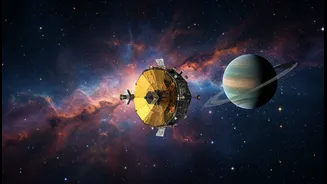
Cosmic Icons: A Quick Refresher
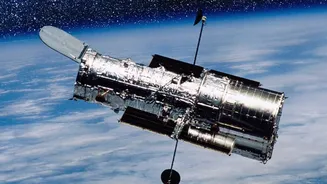
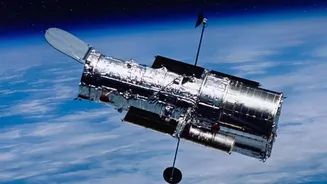
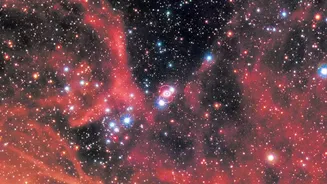
For over three decades, the Hubble Space Telescope has been our reliable eye in the sky, capturing the universe primarily in visible and ultraviolet light. Its high-resolution images have become iconic, leading to breakthroughs in nearly every area of
astronomy. Then came the James Webb Space Telescope (JWST), a marvel of engineering designed to see the universe in infrared light. With its giant, 6.5-meter golden mirror, Webb peers through cosmic dust to witness the birth of stars and the formation of the very first galaxies, looking further back in time than ever before. Webb is a specialist, designed for deep, sensitive observations of specific targets. Think of Hubble as a brilliant general practitioner and Webb as a world-class surgeon for focused, deep cosmic exploration.
Roman's Superpower: The Panoramic View
The single biggest difference with the Nancy Grace Roman Space Telescope is its incredible field of view. While Hubble and Webb are like looking at the sky through a keyhole, Roman offers a panoramic window. Its Wide Field Instrument can capture an area of the sky at least 100 times larger than Hubble or Webb can in a single shot, all while maintaining the same sharp, Hubble-like image quality. To put it in perspective, where Hubble might capture a single stunning feature like the Pillars of Creation, a single Roman image could see the Pillars and the vast star-forming nebula surrounding them. This ability to rapidly survey huge swaths of the sky is what makes Roman a game-changer. It's built for cosmic quantity, designed to map the universe with unprecedented speed and efficiency.
Different Tools for Different Questions
These telescopes are not in competition; they are designed to answer different fundamental questions. Webb's primary mission is to study the early universe and the atmospheres of exoplanets with extreme detail. Roman, on the other hand, has two main goals: to hunt for the mysterious dark energy and dark matter that shape our universe, and to conduct a massive survey for exoplanets. By imaging over a billion galaxies, Roman will map the large-scale structure of the cosmos over time, which will help scientists understand the effects of dark energy's accelerating expansion. For exoplanets, Roman will use a technique called gravitational microlensing to find thousands of new worlds, including those farther from their stars or even rogue planets that don't orbit a star at all.
Technology and Teamwork
While Roman's primary mirror is the same size as Hubble's at 2.4 meters, its instrumentation is what sets it apart. It has two main tools: the Wide Field Instrument (WFI) for its massive surveys, and a technology demonstration called the Coronagraph Instrument. This coronagraph is designed to block the overwhelming glare from a star, allowing Roman to take direct images of Jupiter-sized planets orbiting it—a capability far beyond what Hubble was designed for. The true power, however, will come from teamwork. Roman will be a discovery machine, identifying countless new targets across the sky. Webb, with its powerful but narrow view, can then perform detailed follow-up observations on the most interesting objects Roman finds. Roman finds the needle in the cosmic haystack; Webb studies the needle under a microscope.