





The Ultimate Recycling Challenge
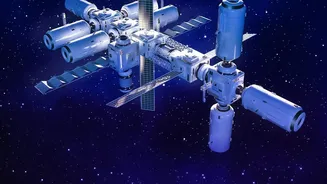
On the International Space Station (ISS), and for future habitats on the Moon and Mars under the Artemis program, there are no taps to turn. Resupplying water from Earth is incredibly expensive and, for a Mars mission, practically impossible. The solution
is a closed-loop system, part of the Environmental Control and Life Support System (ECLSS). This marvel of engineering collects every drop of moisture it can—from crew members' breath and sweat captured by dehumidifiers, to wastewater from hygiene, and even urine. The goal is to purify this collected water and make it drinkable again, creating a self-sustaining cycle. On the ISS, the system has achieved an impressive 98% water recovery rate, producing water that is often cleaner than what comes out of most taps on Earth.
From Urine to Drinking Water
The process is a multi-stage feat of science. Wastewater is first collected and sent to a Water Processor Assembly. Urine undergoes a separate initial process, often involving vacuum distillation, which boils it at a low pressure to separate water vapor from waste products. This vapor, along with all other collected wastewater, then goes through a rigorous purification journey. It passes through a series of specialized filters to remove particles and contaminants. A high-tech catalytic reactor breaks down any remaining organic compounds. Sensors constantly check the water's purity, and if it doesn't meet strict standards, it's sent back to be reprocessed until it does. The final step often involves adding a small amount of iodine or using other methods to prevent any microbial growth during storage.
Artemis and the Next Generation
While the ISS system is a proven success, missions to the Moon and Mars require even more robust and self-sufficient technologies. Research for the Artemis program is pushing these concepts further. NASA is developing systems that not only recycle water but also recover nutrients from wastewater to be used as fertilizer for growing plants. One project recently sent to the University of North Dakota for testing is a deployable facility that uses specialized bioreactors to process different waste streams separately for maximum efficiency. The goal is to create a truly bioregenerative life support system, reducing dependence on Earth for both water and food, and even potentially producing materials like bioplastics for 3D printing.
Technology Transfer to Earth
The incredible irony is that the technology designed for the driest place imaginable—space—holds immense promise for water-scarce regions on Earth. Many of the principles and components developed by NASA have been adapted for terrestrial use. Filter technologies like NanoCeram, which uses positively charged microscopic fibers to attract and trap contaminants, were optimized with NASA funding and are now used in portable water bottles and purification systems around the globe. Earlier systems developed for the Apollo and Space Shuttle missions, which used silver or iodine ions to purify water, have also been commercialized and deployed in developing nations, industrial cooling towers, and even dental offices.
Pilot Programs and Future Potential
The link between space and Earth is becoming more direct. Modular and scalable versions of NASA's bioreactor systems are being considered for municipal and industrial water treatment. The technology's ability to handle highly concentrated wastewater from small crews is perfectly suited for remote communities, disaster relief scenarios, or off-grid installations. These systems not only provide clean water but also offer a way to recover valuable resources like nitrogen for fertilizer, turning a waste problem into a sustainable solution. By forcing engineers to solve for the most extreme environment, the Artemis program is accelerating the development of technologies that can build resilience against water scarcity for everyone.