



Venus: The Shrouded Twin
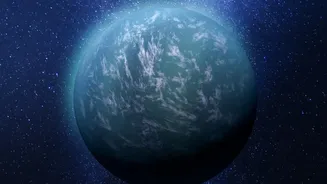
Often called Earth's "twin" due to its similar size and mass, Venus is anything but hospitable. Its surface is a scorching landscape with temperatures over 460°C, and the atmospheric pressure is over 90 times that of Earth's. But the biggest challenge
for scientists has always been the planet's permanent, opaque cloud cover. These aren't water clouds like on Earth; they are thick layers of sulfuric acid that block visible light, effectively hiding the entire surface from conventional telescopes. This is why, despite being our neighbour, we know less about the Venusian surface than we do about distant planets. To understand its geology, volcanic activity, and evolution, we need a way to see through the veil.
Enter Shukrayaan: India's Ambitious Quest
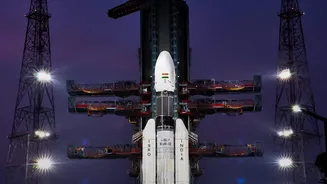
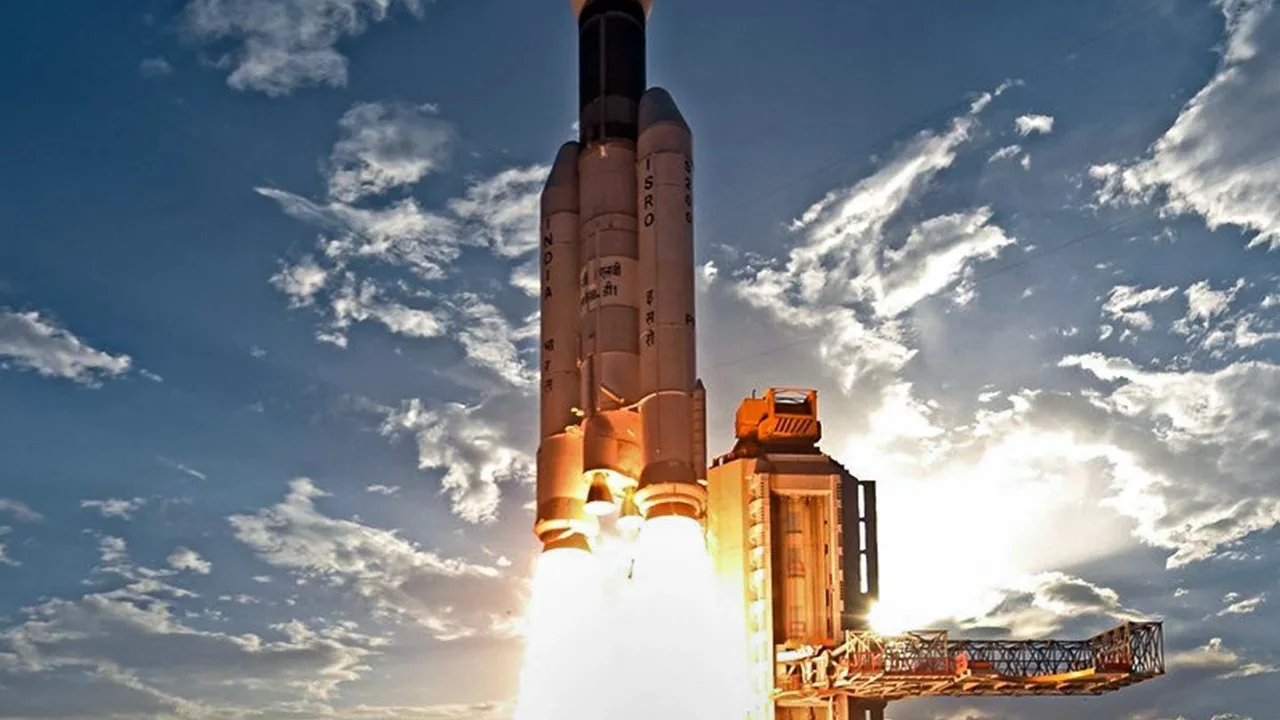
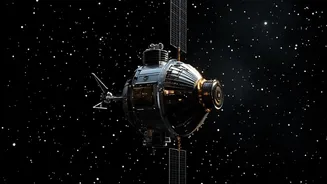
Following its celebrated missions to the Moon (Chandrayaan) and Mars (Mangalyaan), the Indian Space Research Organisation (ISRO) is setting its sights on Venus. The Venus Orbiter Mission, named Shukrayaan-1, is India's first dedicated mission to our shrouded neighbour. Scheduled for a March 2028 launch aboard the powerful LVM-3 rocket, the same vehicle that carried Chandrayaan-3, the orbiter is designed to study the planet from its atmosphere down to its subsurface. The government officially approved the mission in 2024, cementing India's commitment to peeling back the layers of mystery surrounding Venus. The core of this mission lies in a suite of advanced instruments designed specifically for the Venusian challenge.
The Star Instrument: Synthetic Aperture Radar
The primary tool for piercing Venus's clouds is a high-resolution Synthetic Aperture Radar, or SAR. Unlike a regular camera that needs light, a radar works by sending out radio waves and analysing the echoes that bounce back. Because these radio waves can travel through clouds, darkness, and bad weather, the SAR can map the surface regardless of conditions. Shukrayaan's S-band SAR (VSAR) is designed to be even more powerful than previous Venus missions, offering a much higher resolution to capture detailed images of geological features. This will allow scientists to look for active volcanic hotspots, lava flows, and impact craters, providing a comprehensive map of the planet's hidden terrain.
Peering Beneath the Veil: Ground-Penetrating Radar
Shukrayaan is not just stopping at the surface. For the first time on any Venus mission, ISRO will employ a ground-penetrating radar. This instrument, known as VARTISS, uses lower-frequency radar waves designed to penetrate the planet's crust. The goal is to investigate the shallow subsurface stratigraphy—the layering of rock and soil—up to a depth of several hundred meters. This is a groundbreaking objective, as no previous mission has ever studied the subsurface of Venus. By looking beneath the surface, scientists hope to understand the planet's geological history and structure in unprecedented detail.
A Symphony of Science
While radar is key to seeing the surface, Shukrayaan will carry a full suite of about 19 instruments to create a holistic picture of the planet. These include Indian-made payloads alongside international contributions from Sweden, Russia, and Germany. Instruments like thermal cameras will map temperature variations, while spectrometers will analyse the chemical composition of the dense, super-rotating atmosphere. Another key objective is to study the interaction between the Venusian ionosphere and the solar wind, which is a continuous stream of charged particles from the Sun. This comprehensive toolkit will provide crucial data on everything from atmospheric dynamics to the planet's potential for volcanic activity.