



Dario Amodei, the CEO of AI-powerhouse Anthropic, has made a stunning prediction: AI could make cancer a 'relic of the past' in under a decade. This bold claim places a high-stakes bet on technology's power to solve one of humanity's greatest challenges.
A Vision of an AI-Powered Future
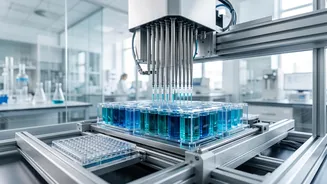
During an IPO roadshow video, Anthropic CEO Dario Amodei suggested that artificial intelligence has the potential to compress 50 to 100 years of medical progress into the next five to 10 years. He stated that diseases like cancer, Alzheimer's, and heart disease could become 'relics of the past' within that timeframe. This isn't just talk; Anthropic is actively pursuing this goal. The company has partnered with several biotechnology firms, including Bristol Myers Squibb, to use its AI, Claude, to accelerate drug discovery. One collaboration has already yielded a redesigned immune cell receptor that is more effective at killing tumour cells in lab tests. Amodei's conviction is personal; his father passed away from hepatitis C just a few years before a cure became widely available, fueling his sense of urgency.
How AI Is Already Changing the Game
Amodei's prediction builds on the real-world progress AI is already making in oncology. AI algorithms are becoming indispensable tools across the entire spectrum of cancer care. In diagnostics, AI helps radiologists detect cancers earlier and more accurately from scans, sometimes spotting signals invisible to the human eye. For example, one trial found AI-assisted mammography screening caught more cancers than human radiologists alone. In research, AI systems like Google DeepMind's AlphaFold are predicting the 3D structures of millions of proteins, a breakthrough that helps scientists design new drugs with incredible speed and precision. AI can also sift through immense volumes of scientific literature and patient data to identify patterns, predict which patients will respond best to certain treatments, and even optimize the design of clinical trials.
The Sobering Reality Check
Despite the optimism, many scientists and medical experts urge caution. They argue that curing cancer is not merely an 'intelligence-limited problem' that more computing power can solve. Cancer is not a single disease but over 200 distinct, complex diseases. Dr. Emilia Javorsky, a physician and researcher, argues that while AI is a revolutionary tool, biology has fundamental rules that we cannot simply compute; they must be measured through slow, methodical experimentation. The biggest bottleneck remains the lengthy process of human clinical trials, which AI cannot significantly shorten. Promising drug candidates still take years to test for safety and efficacy in people. Critics also point to significant hurdles like data privacy, algorithmic bias, and the sheer complexity of the human body as major obstacles to such a rapid breakthrough.
A New Era of Miracles?
While a definitive 'cure' for all cancers in a decade remains a highly ambitious, and perhaps unlikely, goal, the impact of AI is undeniable. The technology is fundamentally accelerating nearly every aspect of the fight against the disease. It's helping scientists discover previously 'undruggable' targets, design personalized therapies like cancer vaccines, and match patients to clinical trials with unprecedented efficiency. Even if the 10rd year timeline proves too optimistic, Amodei's vision points to a future where developing new treatments takes years, not decades. As he put it, 'If we do this right, we can create an age of miracles where humanity is able to solve problems that have eluded us for millennia'. The journey is just beginning, but the fusion of artificial intelligence and medical science holds the promise of turning that hope into a reality for millions.